
Risk Integrity at Decision Speed
Designing Control for AI-Enabled Enterprises
Executive Introduction
Most organisations believe they control AI risk because they have governance frameworks, model validation processes and three lines of defence.
Yet as AI becomes embedded in operational decision-making, such as credit approval, pricing, fraud detection, customer eligibility and operational optimisation, risk no longer moves at the pace of a committee.
It now moves at the speed of each decision.
In AI-enabled settings:
• decisions are continuous
• model performance evolves dynamically
• human judgement and automation intersect in real time
• risk exposure accumulates before the next periodic review
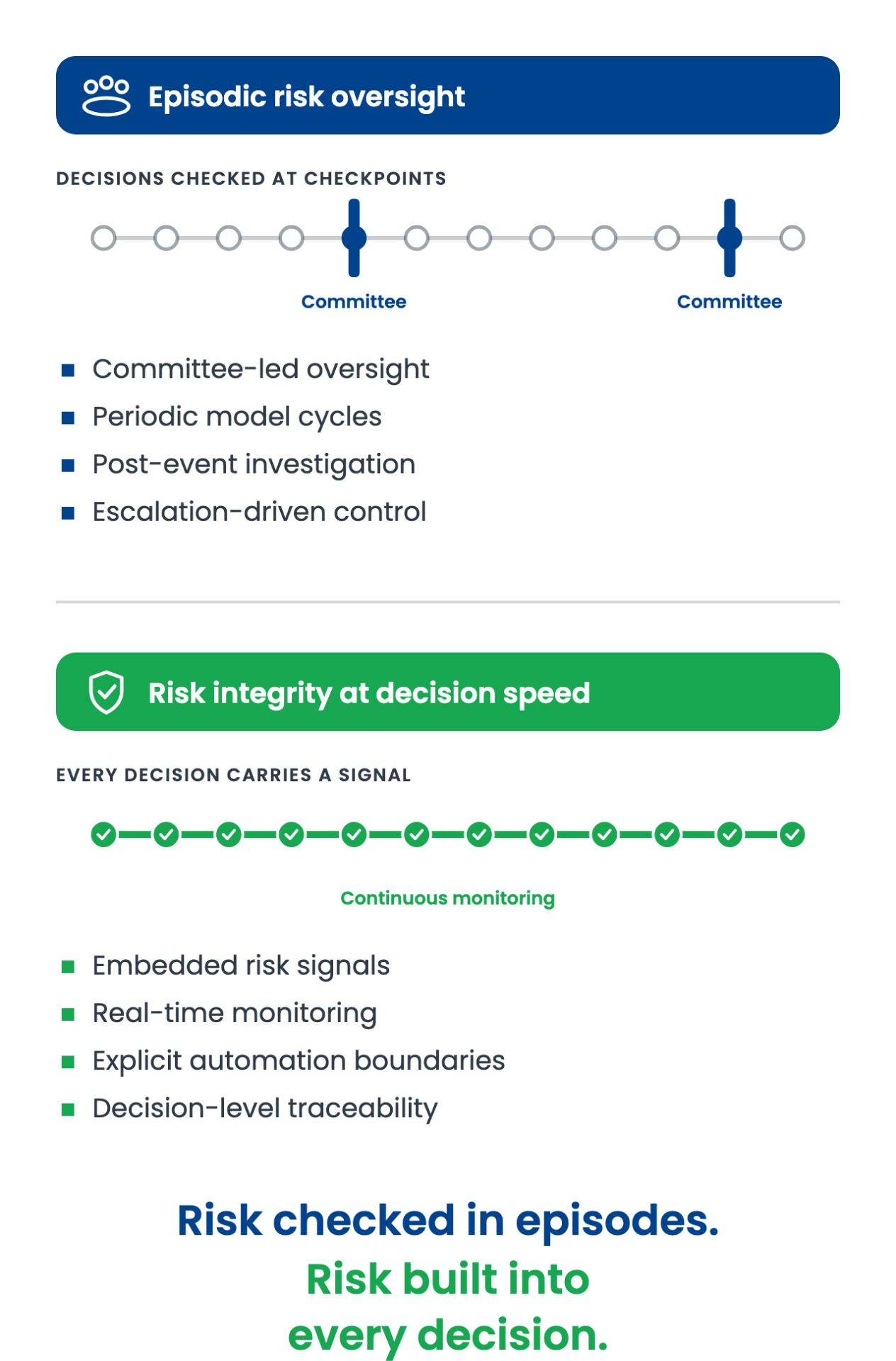
Traditional control structures were designed for batch review, periodic validation and retrospective assurance.
They strain in environments where thousands of AI-assisted decisions are executed every day.
The CRO’s challenge is no longer simply:
• Do we have a risk framework?
• Have models been validated?
• Are policies documented?
The question is now more precise:
Can we demonstrate risk integrity at the speed decisions are now made?
This playbook examines the structural conditions that keep AI-driven decisions traceable, accountable, monitored and defensible in practice as well as in principle.
Why This Matters Now
Supervisory expectations of AI are shifting from policy statements to operational proof.
Across jurisdictions, regulators are moving beyond asking whether AI governance frameworks exist. Increasingly, they ask whether organisations can evidence control in practice.
Examples include:
• The EU AI Act, which requires risk-tiering, traceability and human oversight for high-risk systems
• PRA and FCA expectations on model risk management, operational resilience and accountability under SM&CR
• SR 11-7, the US Federal Reserve’s supervisory guidance on model risk, which emphasises lifecycle validation and monitoring
• Alignment with the NIST AI RMF and emerging ISO/IEC standards on AI governance
At the same time, AI deployment is accelerating:
• generative AI embedded in customer interaction
• automated decisioning in credit, underwriting and pricing
• real-time fraud and risk scoring
• operational optimisation driven by predictive models
This creates a structural tension:
• regulatory scrutiny is intensifying
• decision velocity is increasing
• model complexity is rising
Risk functions designed around periodic model review and committee-based oversight are now expected to operate where exposure accumulates continuously.
The question is no longer whether AI is governed.
It is whether governance scales at the speed of AI.
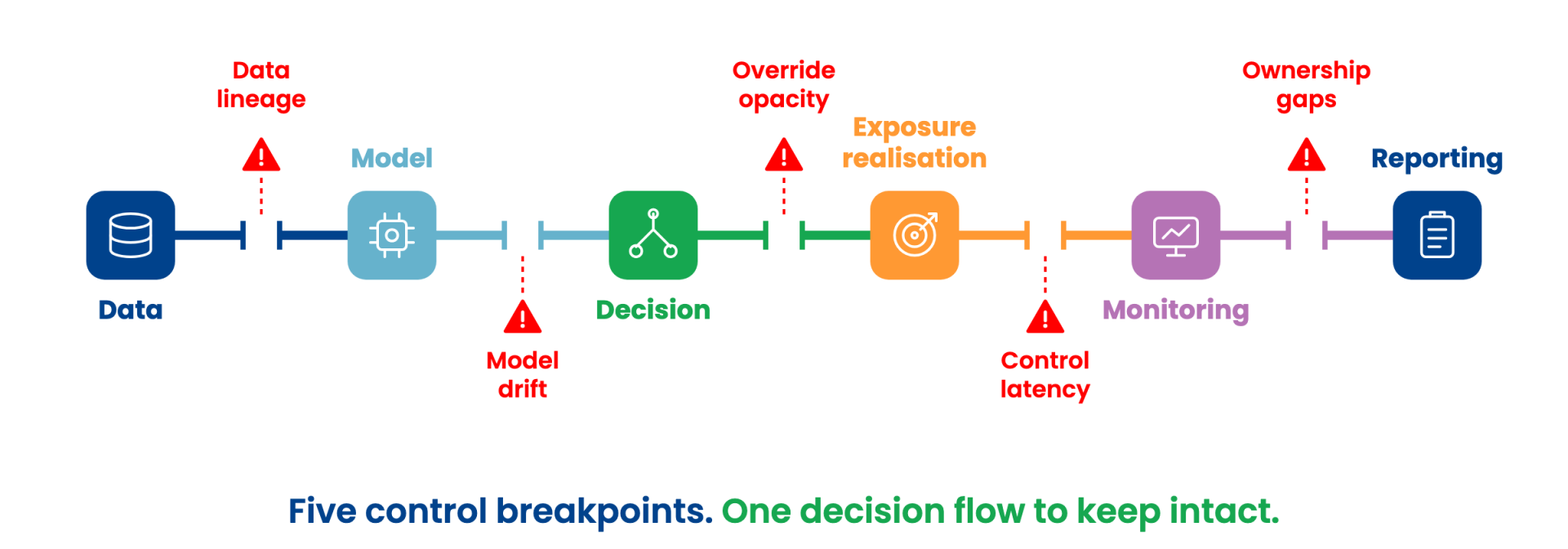
The Structural Conditions for Risk Integrity
Four structural conditions must be in place for risk integrity to hold at decision speed.
In AI-enabled environments, risk integrity depends on whether the enterprise can make decisions traceable, controls operational, accountability explicit and monitoring continuous.
Decision Traceability
Material AI-assisted decisions are reconstructable, with data inputs, model logic, overrides and outcomes linked at decision level.
Control-in-Motion
Controls operate at the execution point rather than retrospectively. Risk signals are embedded in workflows, so issues surface before exposure materialises.
Named Accountability
Human accountability remains explicit at automation boundaries, and ownership is evidenced in practice rather than assumed in policy.
Continuous Risk Monitoring
Model performance, data drift and behavioural impact are monitored in near real time, not only through periodic review or audit cycles.
A Data Operating Model provides the structure that connects data, decisions, controls and evidence in one coherent risk architecture.
What Traditional Risk Frameworks Miss
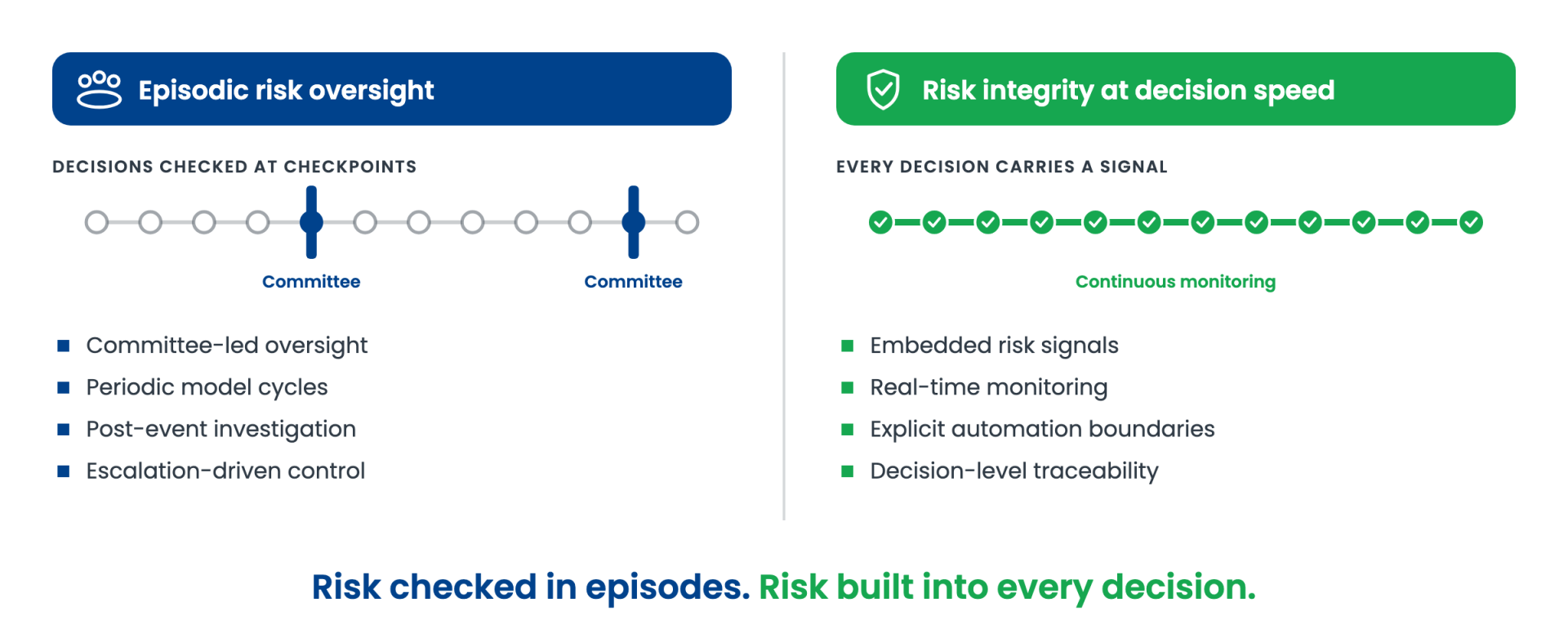
Traditional risk frameworks are designed to optimise control clarity and oversight discipline.
They typically strengthen:
• governance documentation
• model validation cycles
• policy definition
• escalation protocols
These are necessary foundations, but they were designed for environments where decisions were slower, fewer, and centrally reviewed.
They rarely embed:
• evidence generated at decision time
• automation-aware accountability boundaries
• continuous monitoring signals
• lifecycle risk traceability
AI does more than increase model risk.
It also increases:
• decision volume
• decision velocity
• decision autonomy
Risk architecture must evolve accordingly.
When Supervision Goes Deep
Risk integrity is tested under supervisory deep-dive, where principles alone carry little weight.
In practice, regulators and internal audit functions increasingly ask:
• Can you reconstruct how this decision was made?
• Which data inputs influenced the model outcome?
• Where did human override occur, and why?
• How was model performance monitored at the time?
• Who was accountable when the decision was executed?
If the answers require retrospective reconstruction, the risk architecture is not operating at decision speed.
In supervisory reality, policy clarity is necessary, but demonstrable control under scrutiny is decisive.
What Good Looks Like — Risk As a System Property
Executive Risk Self-Test — Structural Integrity Check
These questions test whether risk integrity is structurally embedded or depends on policy and retrospective review.
Decision Reconstruction
Can we reconstruct material AI-assisted decisions end-to-end?
Automation Boundaries
Is human accountability explicit at automation boundaries?
Continuous Monitoring
Are model performance and drift signals visible continuously?
Proportional Governance
Can we demonstrate proportionate control under scrutiny?
Supervisory Readiness
Would our AI control environment withstand regulatory deep-dive?
Integrated Risk System
Do risk and execution operate as one system?
Closing Reflection
The closing point is one of scale and pace.
Greater decision volume, decision velocity and decision autonomy change what a risk framework has to do.
In that environment, risk frameworks designed only for periodic oversight are insufficient.
Risk integrity must operate at the same speed as the decisions it governs.
Traceability must exist at decision level.
Accountability must remain explicit at automation boundaries.
Monitoring must be continuous rather than retrospective.
Governance must be proportionate and executable.
Where these conditions are designed into the operating system, AI can scale within risk appetite.
Where they are not, exposure scales faster than value.
Executive Playbooks

Executive Playbooks
Board-level playbooks designed to help senior leaders navigate enterprise-wide transformation in AI-enabled environments — examining confidence in value, accountability, governance, and control as organisational speed and complexity increase.
Insights from Data Inc
Ideas. Evidence. Measurable Outcomes.
Explore our latest articles and analyses, from AI and data governance to sustainable transformation.
Stay informed, inspired and ahead with insights that can transform your approach to data leadership.

Envalue™ Now Carries IFRS Standards Inside
A return is only as sound as the investment it is measured against.

Data Inc Joins the Claude Partner Network
London, July 2026 — Data Inc is pleased to announce that it has been selected as a member of the Claude Partner Network, Anthropic’s authorised partner programme for organisations that build Claude into their enterprise products and services. Data Inc joins the...

Transformation Has Always Been the Work
Transformation Has Always Been the Work The pace of change in enterprise technology continues to accelerate. AI is now a central part of that conversation, shaping how organisations think about growth, efficiency and scale. What stays consistent, however, is where...

Data Inc appointed to provide ISAE 3000 assurance for major UK Bank
London, January 2026 — Data Inc has been appointed by a global bank to give independent assurance on the replacement of its client account and asset platform. The work centres on data integrity, proof of customer value and control traceability at every step. The...

Scaling SME Performance through Connected Value Systems
Data democratization is revolutionising how organisations handle information by making data accessible to all employees, not just data analysts. This blog explores how companies like the Royal Bank of Scotland are leveraging this inclusive approach to enhance decision-making and customer experiences. Discover the key strategies for implementing effective data democratization, from adopting advanced analytics tools to ensuring robust data governance, and learn why this shift is essential for any competitive business in the digital age.

The Data Operating Model of Transformation
Data democratization is revolutionising how organisations handle information by making data accessible to all employees, not just data analysts. This blog explores how companies like the Royal Bank of Scotland are leveraging this inclusive approach to enhance decision-making and customer experiences. Discover the key strategies for implementing effective data democratization, from adopting advanced analytics tools to ensuring robust data governance, and learn why this shift is essential for any competitive business in the digital age.