
Life Sciences
Accelerating Scientific, Regulatory and Commercial Execution Through Controlled Data

Success in life sciences depends on faster scientific insight, regulatory integrity and manufacturing discipline. The edge goes to those with speed to approval, validated execution and capital-efficient scale, from discovery to development and commercialisation.
For life sciences organisations, the foundation is a life-sciences-specific enterprise ontology. Data Inc builds it to link research, clinical, regulatory, manufacturing and commercial data in one governed execution spine. Decisions are then traceable, validation is built in, and compliance evidence is captured as the work happens.
Customer Experience
Purpose
Bring patient, HCP, medical and commercial insight into governed journeys that link therapy, channel and consent. This supports targeted engagement and field effectiveness.
Outcome
Higher adherence and therapy performance, with decisions that stay auditable across consent, claims, safety and promotional compliance.
Profitability, Value and Growth
Purpose
Link portfolio, launch, supply and commercial economics in one governed value model. It ties evidence, access strategy and forecast accuracy to growth decisions.
Outcome
Launches that are easier to predict and better use of capital, backed by traceable drivers across R&D, market access and in-market performance.
Climate, Sustainability and ESG
Purpose
Track ESG data for each product and site across energy, waste, logistics and suppliers. Link emissions and stewardship metrics to validated reporting and operational action.
Outcome
Defensible ESG disclosures and measurable reduction pathways, with auditable calculations and consistent data lineage across the value chain.
Risk, Compliance and Trust
Purpose
Build controls, evidence and governance into GxP data and AI delivery. This ties validation, data integrity and model oversight to regulator-ready execution.
Outcome
Ready for inspection sooner, with fewer rounds of remediation, backed by continuous evidence, auditability and clear accountability.
Digital Transformation and Innovation
Purpose
Modernise platforms and operating models for AI-native life sciences, linking data products, workflow automation and validated engineering patterns from lab to plant to market.
Outcome
Faster cycles across trials, release and commercial execution, with production-grade delivery discipline and roll-outs that can be repeated.
Operational Resilience and Data-Driven Controls
Purpose
Link critical services, systems, controls and tolerances across R&D, manufacturing and supply. This gives real-time visibility of controls, automated assurance and recovery readiness.
Outcome
GxP operations hold up better under stress, with measurable execution discipline and resilience reports based on evidence.
Industrialising AI in Regulated Life Sciences Environments
AI in life sciences works in validated settings that affect patients, where scientific integrity, data integrity and regulatory confidence are non-negotiable. To scale, it needs controlled execution that keeps GxP validation, privacy discipline and product quality intact from discovery to manufacturing.
Repeatable, audit-defensible AI industrialisation needs a governed execution model. The one Data Inc uses builds in validation, traceability and supervisory readiness from the first step to live use.
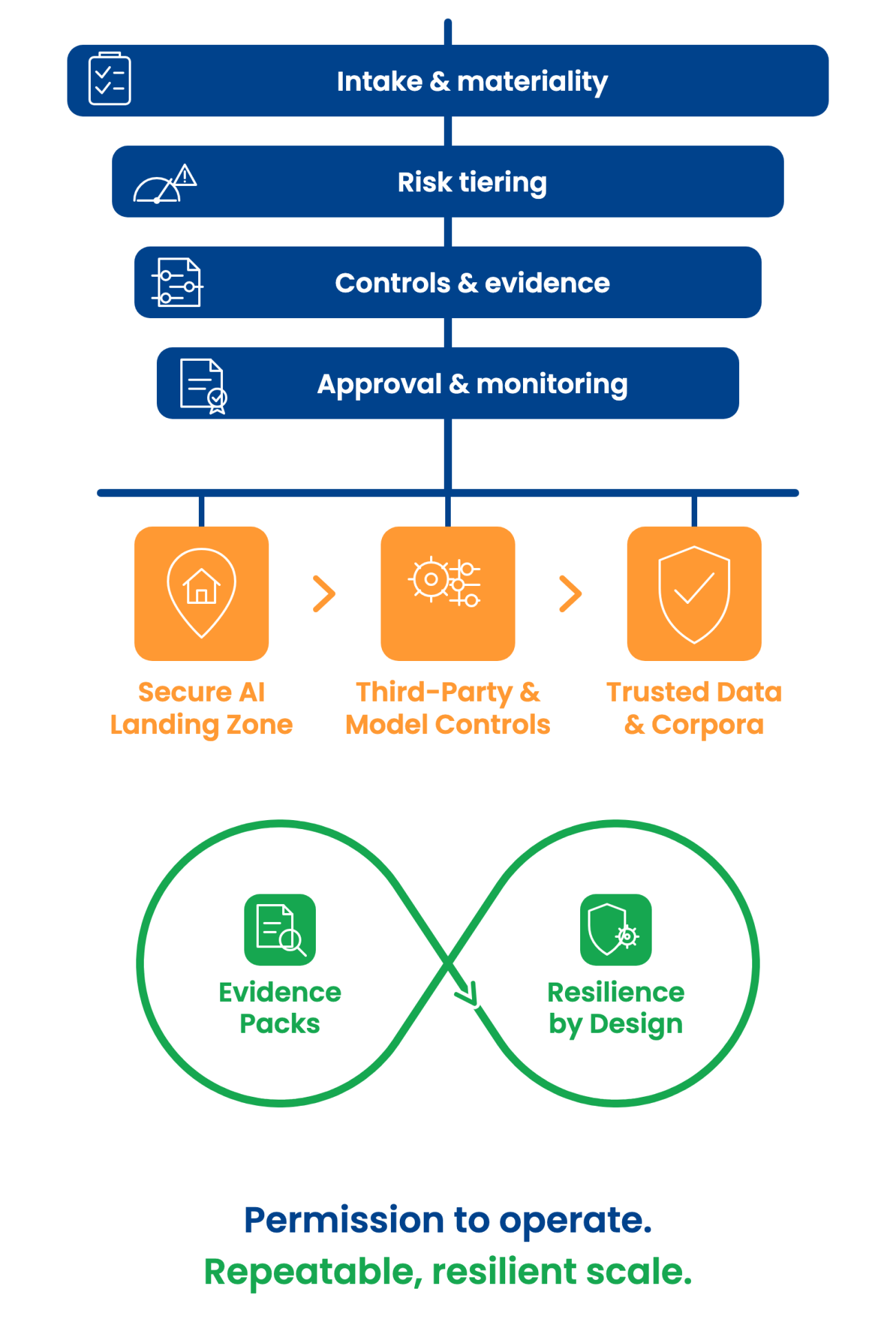
Delivered Within the First 6–8 Weeks
A GxP-calibrated model to rank AI use cases, with an intake workflow that sorts each one by patient impact, regulatory class and validation scope.
An initial AI “permission-to-operate” control standard that sets accountable roles, validation thresholds, the records needed and who can approve a release.
A blueprint for an AI landing zone governed for live use, with audit logs, monitoring, test rules and secure ways to ground AI in data.
Evidence pack templates ready for inspection and in line with GxP needs. They cover data provenance, validation artefacts, change control records and limits for tracking performance.
A ranked portfolio of 5–10 life sciences AI use cases for controlled industrialisation, each chosen on impact, feasibility and regulatory readiness.
Building AI-Ready Capability in Regulated Environments
In life sciences, deploying AI changes accountability as well as productivity across R&D, manufacturing, quality and safety. Automation must strengthen scientific judgement, validation discipline and patient protection, not dilute them.
- AI-Augmented Science & Quality:
Using validated co-pilots and predictive models for R&D insight, QC trend analysis, deviation triage and pharmacovigilance signal detection, with documented oversight. - GxP AI Governance Roles:
Setting accountable owners for model stewardship, validation, quality oversight and inspection-ready assurance as regulatory needs change. - Controlled Workforce Transition:
Giving scientists, QA, manufacturing and compliance teams the data and governance skills to oversee AI systems safely and well.
Entry-level and junior paths are reshaped into roles that carry controls, such as AI quality reviewers, validation evidence analysts and AI operations analysts, which preserves oversight capacity as automation expands.
Adoption stays disciplined. Human validation backs up precise automation, so insight still comes fast and regulators and patients keep their trust.
Ready to Make Your Life Sciences Transformation Measurable?
Scale Innovation Without Compromising Validation or Patient Safety
In life sciences, transformation must work within GxP controls, where data integrity, product quality and patient protection are non-negotiable.
The Integrated Transformation Framework™ builds governance, validation discipline and inspection-ready evidence into research, clinical development, manufacturing and safety work. Together these form a life-sciences-specific enterprise ontology, which puts scientific, regulatory and commercial domains under one control architecture.
Progress becomes measurable: faster insight, lasting compliance and operational resilience that stands up to regulatory scrutiny.
Insights from Data Inc
Ideas. Evidence. Measurable Outcomes.
Explore our latest articles and analyses, from cutting-edge AI and data governance to sustainable transformation.
Stay informed, inspired and ahead with insights that can transform your approach to data leadership.

Envalue™ Now Carries IFRS Standards Inside
A return is only as sound as the investment it is measured against.

Data Inc Joins the Claude Partner Network
London, July 2026 — Data Inc is pleased to announce that it has been selected as a member of the Claude Partner Network, Anthropic’s authorised partner programme for organisations that build Claude into their enterprise products and services. Data Inc joins the...

Transformation Has Always Been the Work
Transformation Has Always Been the Work The pace of change in enterprise technology continues to accelerate. AI is now a central part of that conversation, shaping how organisations think about growth, efficiency and scale. What stays consistent, however, is where...

Data Inc appointed to provide ISAE 3000 assurance for major UK Bank
London, January 2026 — Data Inc has been appointed by a global bank to give independent assurance on the replacement of its client account and asset platform. The work centres on data integrity, proof of customer value and control traceability at every step. The...

Scaling SME Performance through Connected Value Systems
Data democratization is revolutionising how organisations handle information by making data accessible to all employees, not just data analysts. This blog explores how companies like the Royal Bank of Scotland are leveraging this inclusive approach to enhance decision-making and customer experiences. Discover the key strategies for implementing effective data democratization, from adopting advanced analytics tools to ensuring robust data governance, and learn why this shift is essential for any competitive business in the digital age.

The Data Operating Model of Transformation
Data democratization is revolutionising how organisations handle information by making data accessible to all employees, not just data analysts. This blog explores how companies like the Royal Bank of Scotland are leveraging this inclusive approach to enhance decision-making and customer experiences. Discover the key strategies for implementing effective data democratization, from adopting advanced analytics tools to ensuring robust data governance, and learn why this shift is essential for any competitive business in the digital age.