
The Data Operating Model
The Missing Layer Between Vision and Assured Value

Executive Introduction
Most large organisations have a strategy.
Where they struggle is in translating it reliably into measurable enterprise value.
Boards articulate vision,
executives define priorities,
programmes are funded,
technology is implemented
and operating models are redesigned.
And yet value realisation remains uneven, hard to evidence and hard to defend at scale.
This is rarely a failure of intent or capability. It reflects a structural gap.
Between vision and value, most enterprises lack a connecting layer that makes sure:
• decisions are grounded in traceable data
• accountability is explicit and operational
• outcomes produce measurable signals
• value can be evidenced as it is created
What is missing is not more governance, architecture or reporting.
It is a Data Operating Model.
This is different from a data management function,
a target operating model
or an AI operating framework.
It is the structural architecture that connects:
Vision → Strategy → Plan → Decision → Outcome → Measurable Value
Without this layer, transformation becomes episodic.
With it, value becomes systemic.
Why This Matters Now
Enterprise transformation has never been more ambitious, or more fragile.
Organisations are simultaneously:
• renewing legacy platforms
• moving to the cloud
• building in analytics and AI
• reshaping operating models
• facing regulatory and cost pressure
Yet despite record investment, many programmes struggle to deliver measurable, sustained business value.
The issue is rarely capability, effort or intent.
It is structural.
Most transformation is designed around a Target Operating Model, which sets out future processes, structures and technology.
But far fewer organisations design the operating system that governs how:
• decisions are made
• data flows across functions
• controls generate evidence
• outcomes are measured in motion
As speed grows and interdependencies deepen, this structural gap becomes visible.
Value starts to leak, and assurance becomes reactive. Governance adds friction, and delivery fragments.
In an AI-enabled environment, these weaknesses amplify. But they do not begin with AI.
They begin with the lack of a unifying Data Operating Model.
Without a structural foundation for data, transformation grows complexity faster than it grows value.
The Missing Layer
Why transformation collapses even when “people, process, and technology” are in place
Most enterprises already spend heavily on the visible parts of transformation: new platforms, new processes, new roles, and new governance forums.
On paper, the essentials are covered. In practice, outcomes still drift.
That drift is usually explained as a delivery problem: change resistance, execution gaps, poor adoption, scope creep, or data quality.
Those issues are real, but they are often symptoms rather than causes.
The underlying problem is structural: enterprises try to move from vision to value without an operating layer that can consistently:
• turn intent into executable decisions
• keep accountability explicit as work decentralises
• produce outcome signals as a natural by-product of delivery
• keep traceability from plan → execution → business as usual
Without that layer, transformation relies on coordination by human effort: programme leadership, meetings, escalations, steering forums and narrative reporting.
This works for a while, but it does not scale.
As complexity grows, organisations make up for it by adding more of what they already have:
• more governance layers
• more frequent reports
• more dashboards
• more assurance checks
• more controls applied after the fact
This creates the illusion of control while adding friction. Value gets harder to evidence, accountability harder to locate and decisions harder to defend.
The pattern is familiar:
• transformation that progresses, but does not compound
• benefits that are forecast, but not sustained
• operating models that are designed, but cannot be executed
• and outcomes that cannot be proven under scrutiny
A Data Operating Model is the structural architecture that converts change into measurable, defensible, and compounding enterprise value.
In the next section, we define what a Data Operating Model is and how it differs structurally from DAMA, TOMs, AI operating models or governance frameworks.
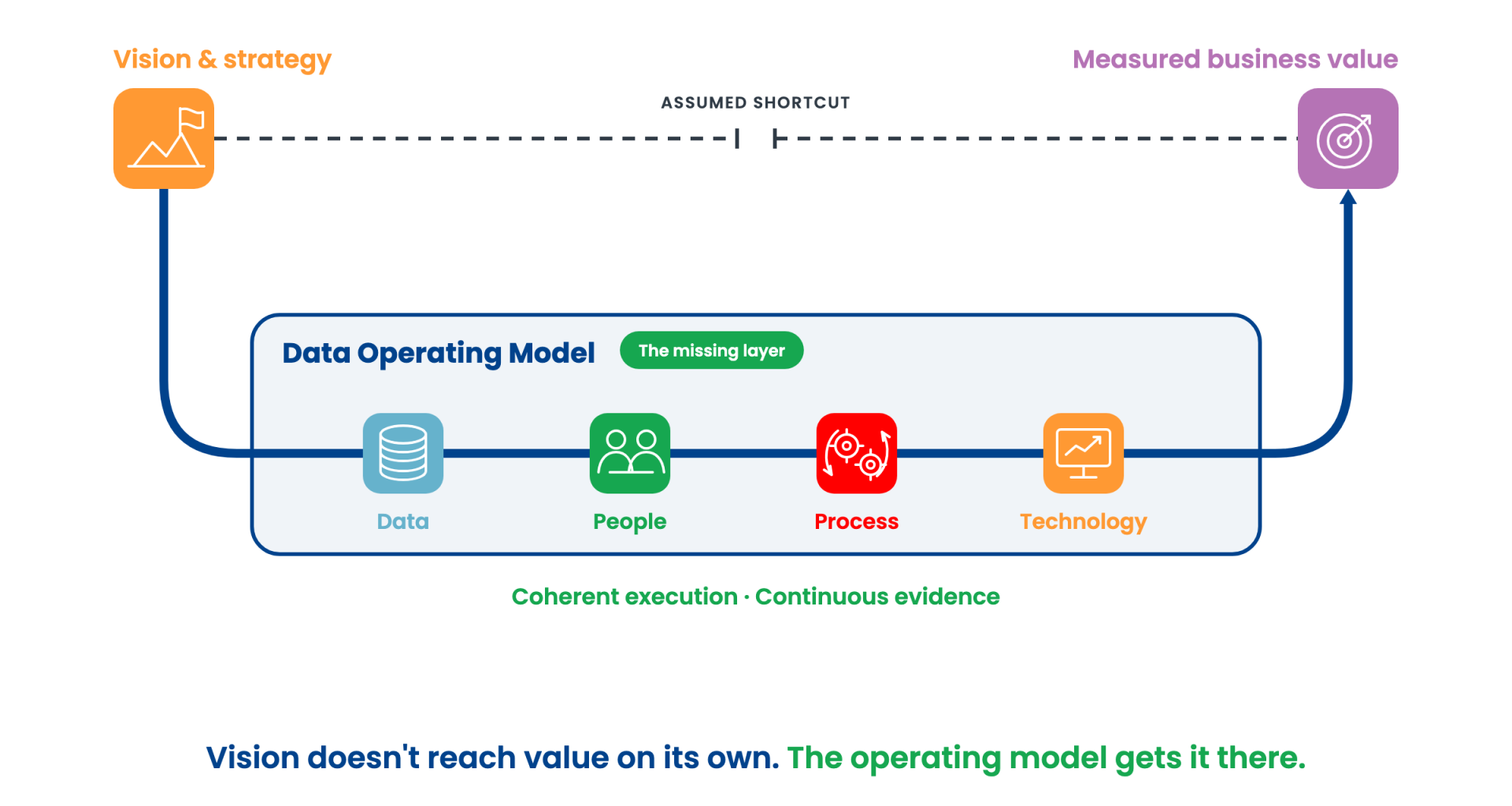
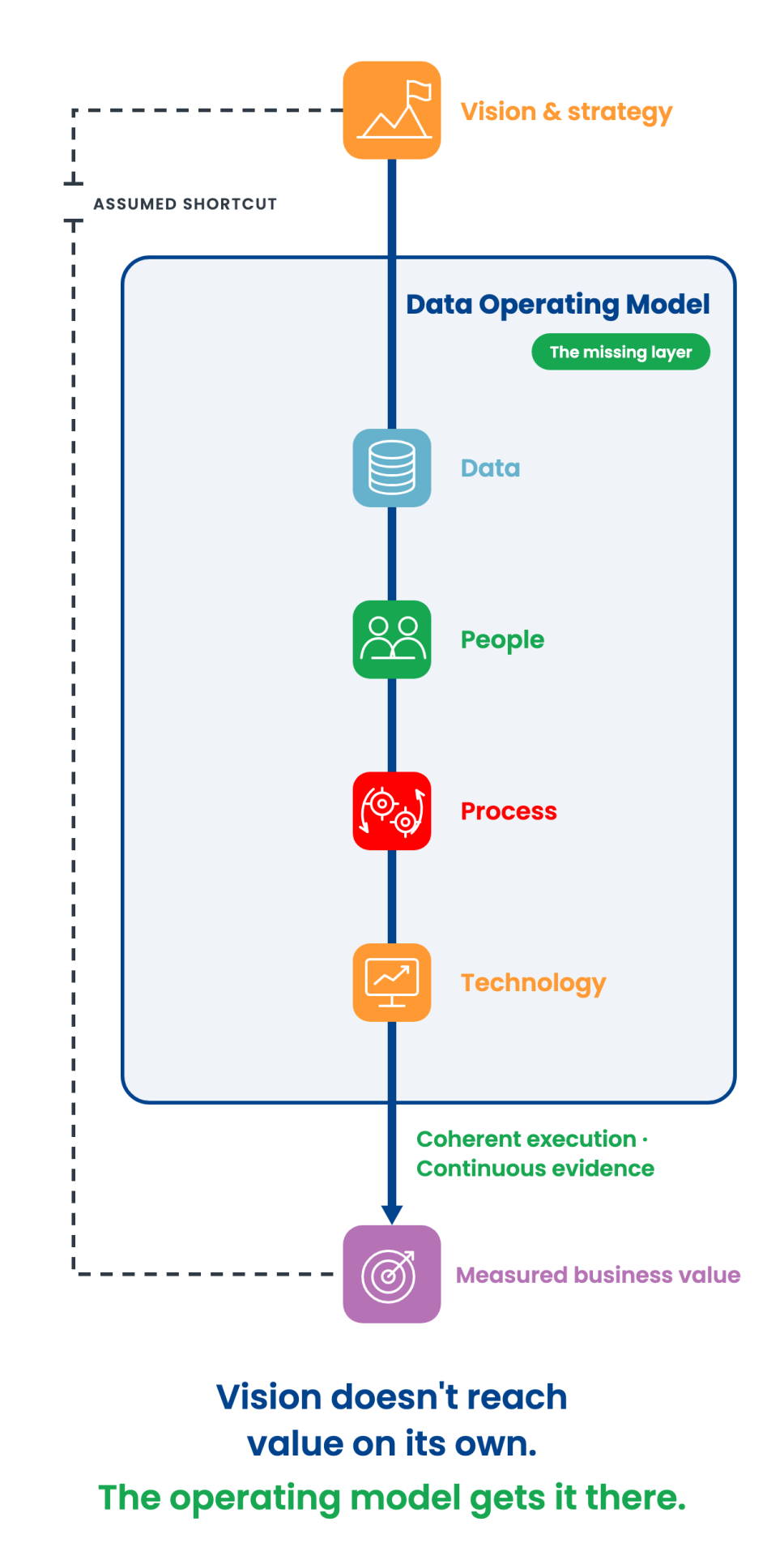
Most transformation programmes begin with vision and strategy and end with reported outcomes.
What is often missing is the structural layer that links intent to execution.
The Data Operating Model is that layer.
It unifies data, people, process, and technology in one coherent system that produces traceable outcomes and measured business value.
Without it, value is only forecast. With it, value can be evidenced.
Why Existing Frameworks Don’t Close the Gap
Most enterprises already operate within recognised frameworks.
Data is governed. Target operating models are documented. AI strategies are underway.
Yet the structural gap between vision and measured business value persists.
The issue is structural coherence rather than capability.
These frameworks optimise important parts of the enterprise, but they do not structurally thread
value measurement,
decision ownership,
evidence generation,
and control-in-motion into a single operating system.
A Data Operating Model exists to close that gap.
DAMA-DMBOK
Focus
Governance & data domains
Limitation
A capability framework rather than a value-threaded execution model.
Target Operating Models
Focus
Structure, process & organisation design
Limitation
Rarely thread measurement, evidence and value into execution.
AI Operating Models
Focus
Experimentation & scaling AI
Limitation
Assume foundational coherence already exists.
What a Data Operating Model Actually Is
A Data Operating Model is the structural system that makes sure every decision, process, and transformation activity is measurably connected to enterprise value.
What it is not
• Not governance theatre
• Not an architecture diagram
• Not a reporting layer
• Not an AI factory
What Makes a Data Operating Model Structurally Different
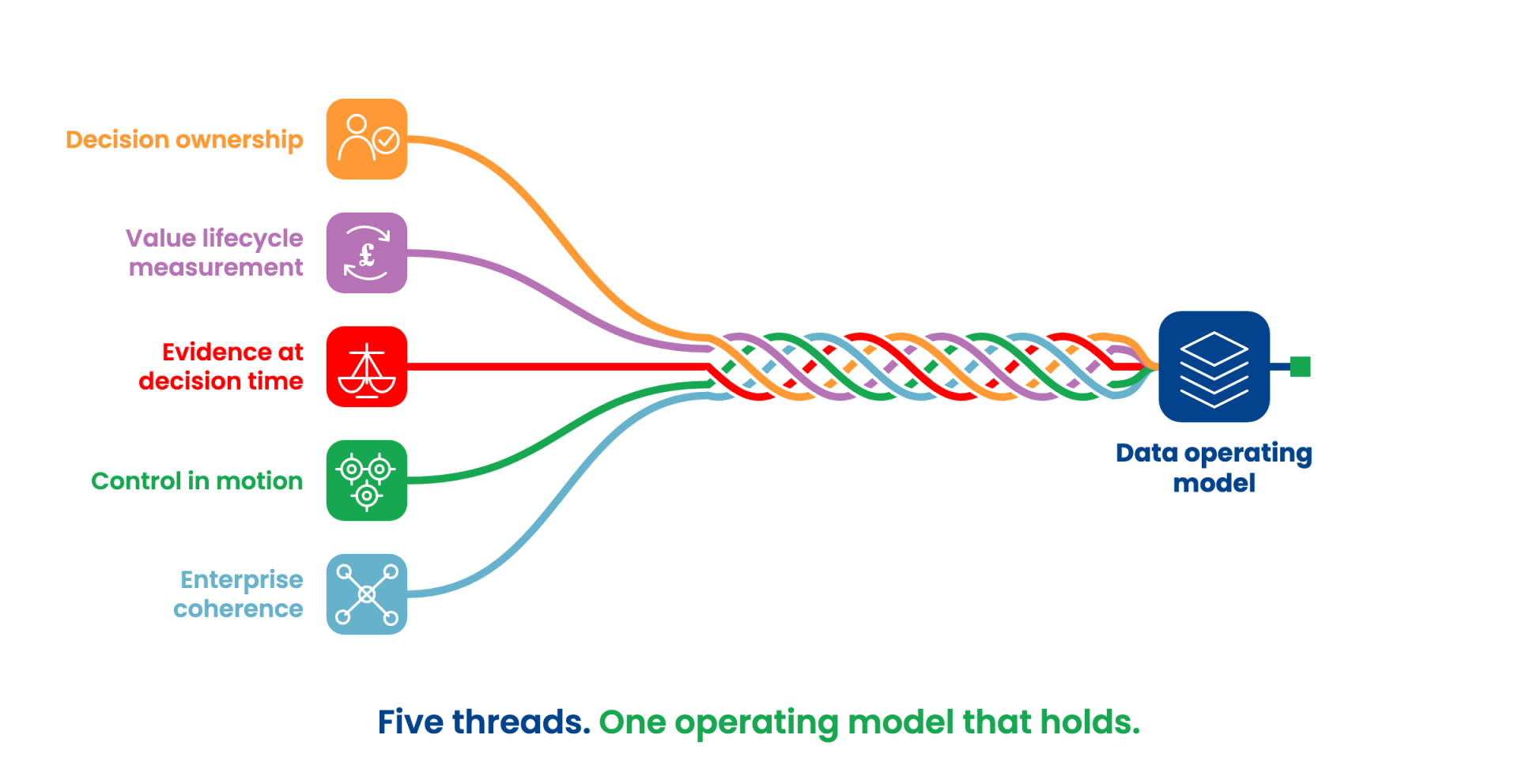
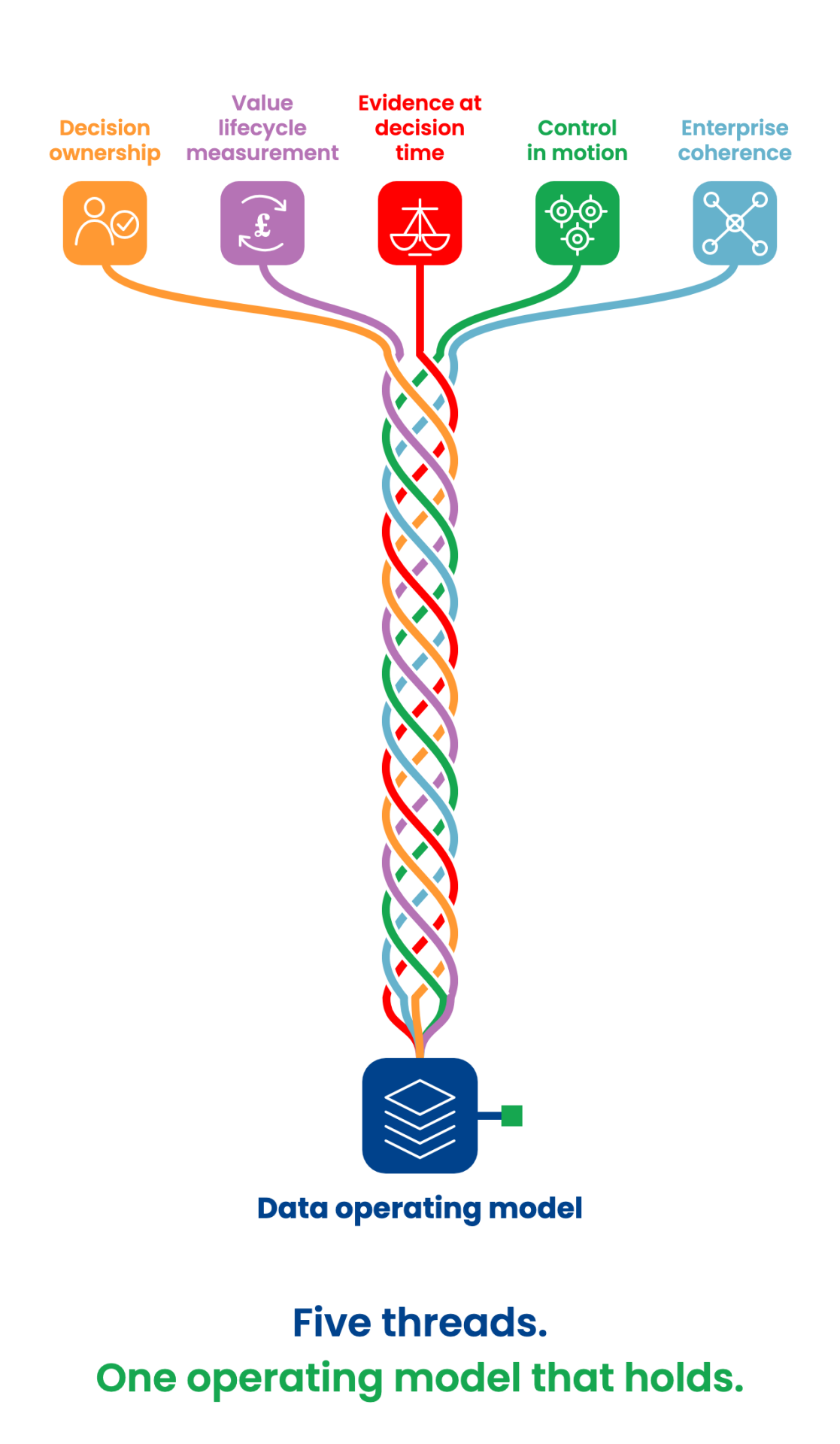
1. It is value-threaded, not capability-framed.
Every decision, control, and process is structurally connected to measurable enterprise outcomes.
2. It embeds measurement at the point of execution.
Value is tracked as it is created, rather than inferred after delivery.
3. It generates evidence at decision time.
Evidence is a structural by-product of work, so nothing has to be assembled after the fact.
4. It unifies governance and delivery.
Control operates continuously within workflows, with no separate checkpoint overlay.
5. It makes enterprise coherence structural.
Strategy, execution, assurance and adaptation operate as one system, where they once ran as parallel functions.
Decision Ownership
Accountability defined at execution speed.
Named decision rights.
Clear escalation paths.
Human judgement where it matters.
Value as Lifecycle
Value tracked from intent to outcome.
Baselines agreed before delivery.
Real-time visibility of risk.
Measurement embedded from the start.
Evidence at Decision Time
Evidence generated as decisions occur.
Traceability built in.
Audit without reconstruction.
Signal over narrative.
Control-in-Motion
Governance embedded in workflows.
Controls operate continuously.
Risk surfaced early.
Assurance without friction.
Enterprise Coherence
Strategy, execution and assurance aligned.
Fewer silos between functions.
Decisions connected end-to-end.
Coherent adaptation as priorities shift.
How It Rewires the Enterprise
A Data Operating Model rewires how the enterprise functions,
instead of sitting alongside it.
People
Decision rights. Judgement. Accountability.
Decision ownership is explicit.
Human judgement is designed into execution.
Accountability exists at decision speed, not after review.
Process
Flow. Measurement. Control-in-motion.
Value is tracked across its full lifecycle.
Evidence is generated as work progresses.
Governance operates within flow, not only at checkpoints.
Technology
Enabler, not authority.
Platforms support decision-making without replacing it.
Automation speeds up execution without obscuring ownership.
Technology becomes a value enabler rather than a substitute for governance.
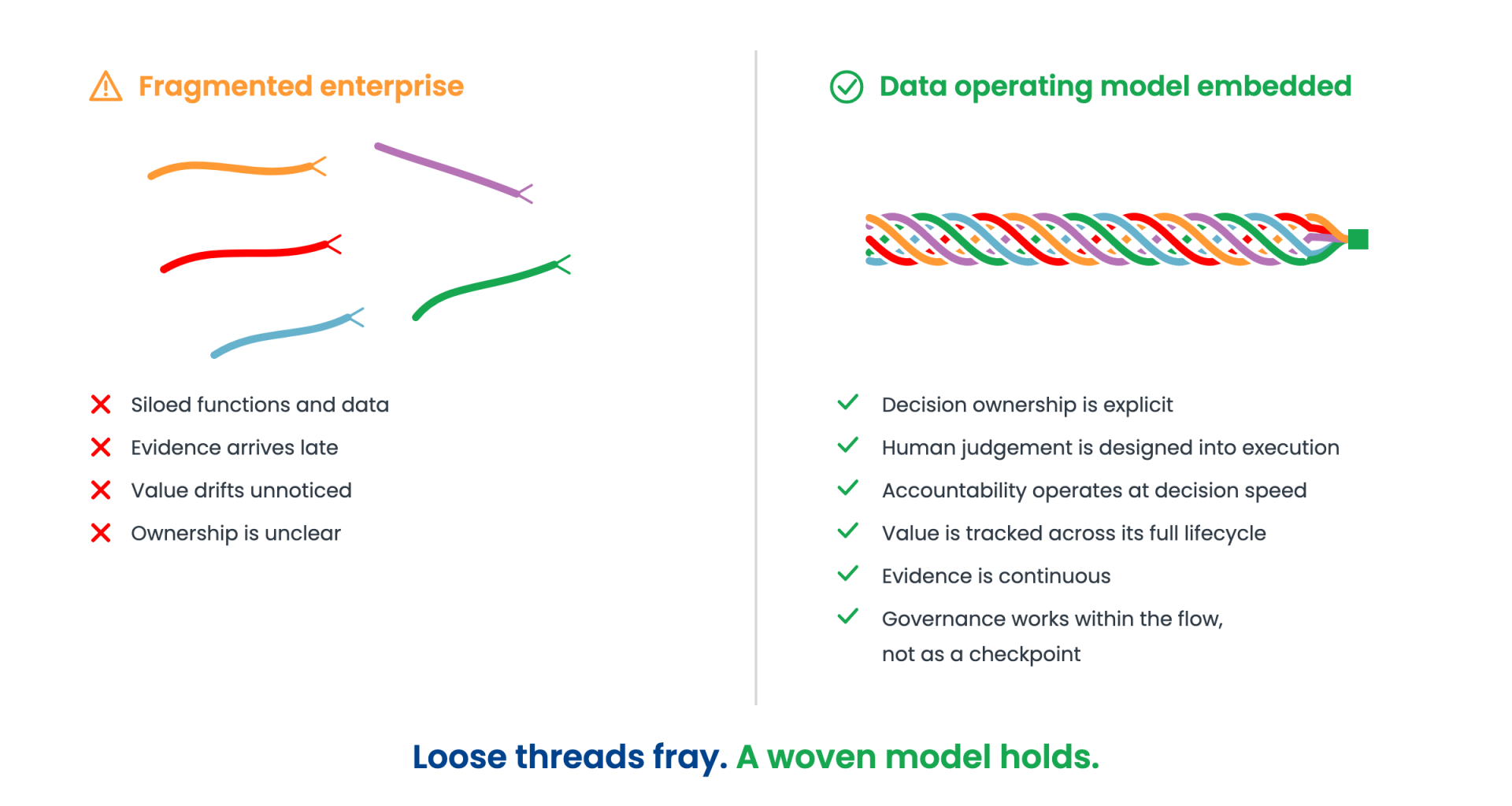
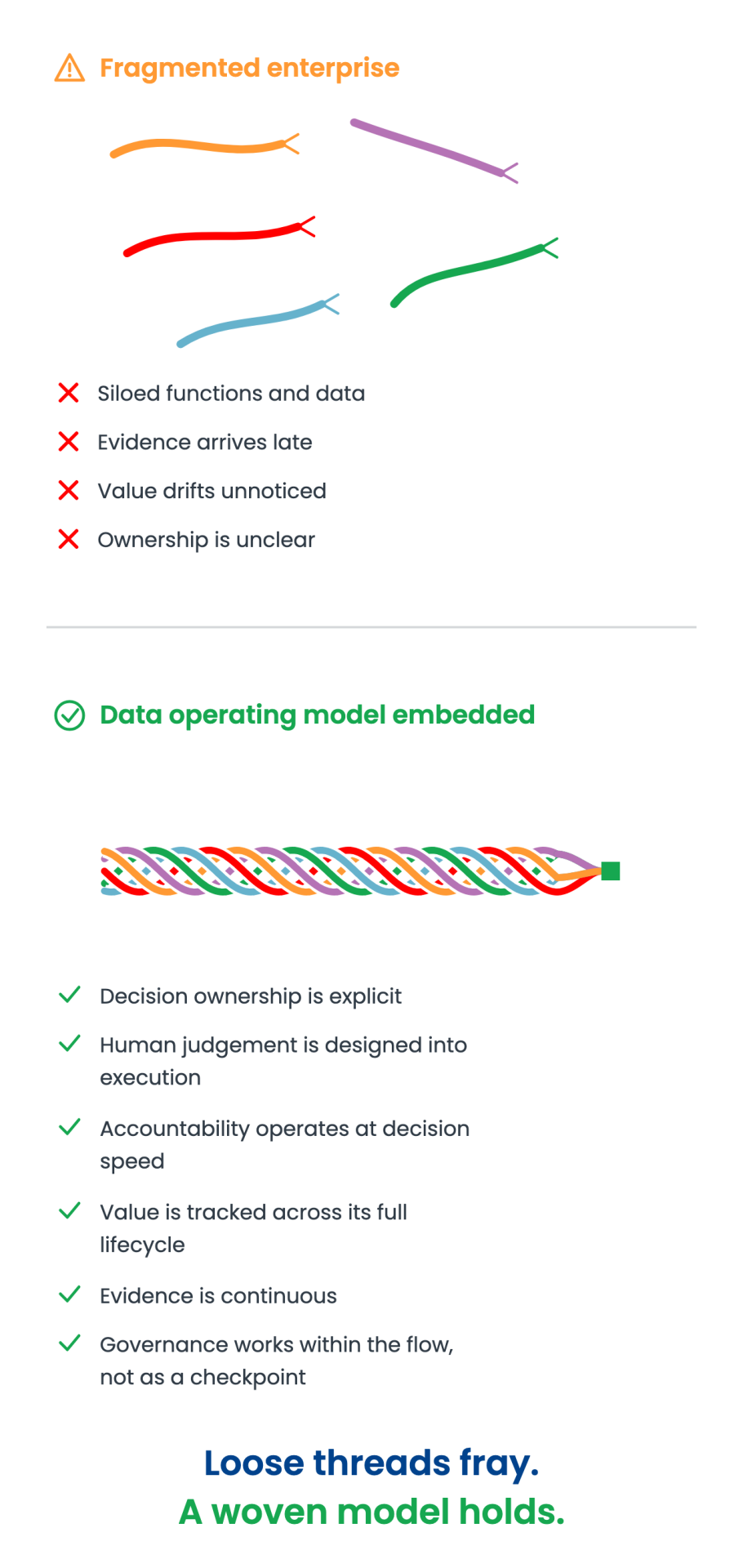
Enterprises that embed a Data Operating Model move faster as a result.
Their value is credible, their evidence is continuous, and decisions can be made with confidence rather than caution.
Why AI Makes This Non-Optional
Artificial intelligence rarely creates structural incoherence.
It exposes and accelerates it.
As AI systems are embedded into pricing, underwriting, customer interaction, forecasting and operational prioritisation:
• decision velocity increases
• the impact of misalignment multiplies
• traceability becomes mandatory
When decisions are continuous rather than episodic, fragmentation compounds faster.
When automation scales, small structural weaknesses become enterprise risks.
When outcomes are questioned, retrospective explanation is no longer sufficient.
A Data Operating Model is different from an AI Operating Model.
It is the structural foundation that allows AI, and any other transformation, to operate coherently, measurably and defensibly.
In an AI-enabled enterprise, this foundation is no longer optional.
Executive Structural Self-Test
This is a structural test.
It does not set out to assess maturity.
If a Data Operating Model truly exists, the answers to these questions should be clear, evidenced and demonstrable, leaving little to interpretation.
1. Value Traceability
Can we trace value from
strategic intent
to
realised outcome
in real time?
2. Decision Ownership
Is decision ownership explicit and evidenced at the
point of automation?
3. Evidence Generation
Is evidence generated
at decision time,
or assembled afterwards?
4. Continuous Governance
Does governance operate
continuously
as work flows, or only episodically?
5. Lifecycle Integrity
Can we demonstrate integrity across the
full value lifecycle,
from intent to BAU?
6. Enterprise Coherence
Does the enterprise adapt
coherently under change,
or fragment under pressure?
Interpreting What You See
These questions do not score maturity.
They surface where coherence depends on assumption rather than design.
If answers rely on:
• reporting → you have dashboards
• architecture diagrams → you have plans
• governance documents → you have intent
If answers rely on:
• evidence
• traceable value
• operational ownership
You have a Data Operating Model.
Closing Reflection
Every enterprise begins with a vision.
That vision is translated into strategy.
Strategy is turned into programmes, platforms, initiatives and change.
Yet between strategy and measurable enterprise outcomes, something critical is often missing:
a structural system that makes sure value is threaded, measured, governed and evidenced end-to-end.
Without that system, transformation generates activity.
With it, transformation generates measurable enterprise value.
A Data Operating Model is more than an enhancement.
It sits beneath the overlays and methodologies an enterprise already uses.
Its role is structural.
It is the missing foundation that connects Vision → Strategy → Execution → Measurement → Assured Value.
In an AI-enabled enterprise, that foundation is no longer optional.
It is the difference between intent and outcome.
Where the Data Operating Model Applies
A Data Operating Model is not tied to a single initiative. It underpins enterprise performance wherever value must be made measurable: across customer experience, growth, sustainability, risk, innovation, resilience and protection.
At Data Inc, this structural layer operates across seven areas:
Profitability, Value & Growth;
Climate, Sustainability & ESG Data;
Digital Transformation & Innovation at Scale;
Operational Resilience & Data-Driven Controls; and
It is structurally aligned to the Enterprise Value framework and embedded within the Integrated Transformation Framework™, so that vision, strategy, execution, governance and assurance operate as one coherent enterprise system.
Executive Playbooks

Executive Playbooks
Board-level playbooks designed to help senior leaders navigate enterprise-wide transformation in AI-enabled environments, examining confidence in value, accountability, governance and control as organisational speed and complexity increase.
Insights from Data Inc
Ideas. Evidence. Measurable Outcomes.
Explore our latest articles and analyses, from AI and data governance to sustainable transformation.
Stay informed, inspired and ahead with insights that can transform your approach to data leadership.

Envalue™ Now Carries IFRS Standards Inside
A return is only as sound as the investment it is measured against.

Data Inc Joins the Claude Partner Network
London, July 2026 — Data Inc is pleased to announce that it has been selected as a member of the Claude Partner Network, Anthropic’s authorised partner programme for organisations that build Claude into their enterprise products and services. Data Inc joins the...

Transformation Has Always Been the Work
Transformation Has Always Been the Work The pace of change in enterprise technology continues to accelerate. AI is now a central part of that conversation, shaping how organisations think about growth, efficiency and scale. What stays consistent, however, is where...

Data Inc appointed to provide ISAE 3000 assurance for major UK Bank
London, January 2026 — Data Inc has been appointed by a global bank to give independent assurance on the replacement of its client account and asset platform. The work centres on data integrity, proof of customer value and control traceability at every step. The...

Scaling SME Performance through Connected Value Systems
Data democratization is revolutionising how organisations handle information by making data accessible to all employees, not just data analysts. This blog explores how companies like the Royal Bank of Scotland are leveraging this inclusive approach to enhance decision-making and customer experiences. Discover the key strategies for implementing effective data democratization, from adopting advanced analytics tools to ensuring robust data governance, and learn why this shift is essential for any competitive business in the digital age.

The Data Operating Model of Transformation
Data democratization is revolutionising how organisations handle information by making data accessible to all employees, not just data analysts. This blog explores how companies like the Royal Bank of Scotland are leveraging this inclusive approach to enhance decision-making and customer experiences. Discover the key strategies for implementing effective data democratization, from adopting advanced analytics tools to ensuring robust data governance, and learn why this shift is essential for any competitive business in the digital age.