
Capital Discipline in AI-Enabled Enterprises
From AI Investment to Defensible Enterprise Return

Executive Introduction
Most organisations are not short of AI ambition or investment appetite.
Capital is being deployed rapidly across advanced analytics, automation, GenAI capabilities, cloud platforms and AI-enabled SaaS products. Business cases are modelled, funding is approved and delivery is mobilised.
Yet many CFOs face a persistent challenge:
Can we demonstrate, with confidence, that the AI capital we have deployed is generating durable enterprise return?
After deployment, some patterns often appear:
• run-rate costs grow (cloud, data, model maintenance)
• benefits depend on adoption and stable performance
• attribution blurs across programmes and portfolios
• baselines shift during transformation
• ROI discussions become narrative rather than evidence-led
None of this points to weak modelling or poor intent. It points to a structural gap between capital allocation and decision-level value creation.
Traditional capital governance is built for projects, while AI-enabled enterprises run on continuous decisions, shifting costs and evolving operating models.
When return measurement lags operational reality, capital discipline weakens, even as innovation accelerates.
This playbook sets out four structural conditions that turn AI investment into enterprise value that is measurable, defensible and auditable after go-live.
Why This Matters Now
AI investment is growing faster than traditional capital controls were built to handle.
Organisations are, all at once:
• funding advanced analytics and GenAI initiatives
• growing cloud infrastructure and data platforms
• enabling AI features in existing SaaS products
• trying out proof-of-value use cases
• taking on new run-rate costs for models, data and monitoring
Capital deployment cycles are shortening, competitive pressure is pushing funding decisions earlier and innovation portfolios are widening.
At the same time, CFOs face increasing scrutiny over:
• shorter payback periods
• Opex versus Capex treatment
• attribution of benefits across programmes
• sustainability of AI-driven cost savings
• regulatory and audit defensibility of ROI claims
Traditional return management relies on:
• forecast modelling at the approval stage
• periodic benefit reviews
• post-implementation reconciliation
In AI-enabled enterprises, that lag creates measurement risk. Benefits depend on adoption, model performance stability and behavioural change, while costs keep moving and baselines shift during transformation.
That lag is where capital discipline weakens, however quickly innovation moves.
AI return often erodes because capital governance cannot keep pace with operational reality.
Where Capital Integrity Breaks Down
AI investments rarely fail at the approval stage, where business cases are modelled, returns are forecast and funding is allocated.
Capital integrity starts to weaken after deployment, as initiatives move from build into live use.
The issue is structural rather than a matter of effort or innovation.
Between capital allocation and reported ROI, value can erode in predictable ways.
In AI-enabled settings, this loss tends to gather at five leakage points:
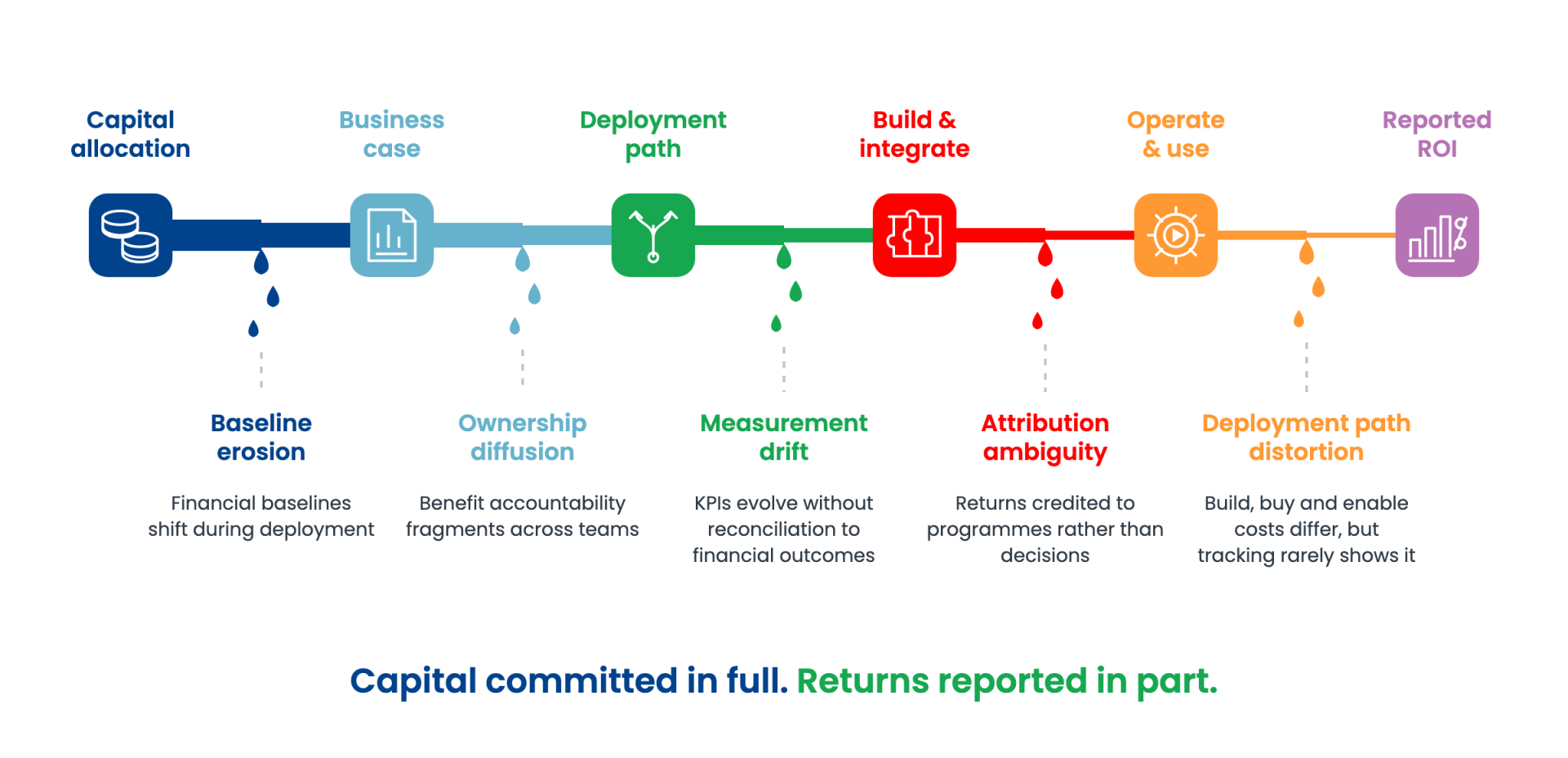
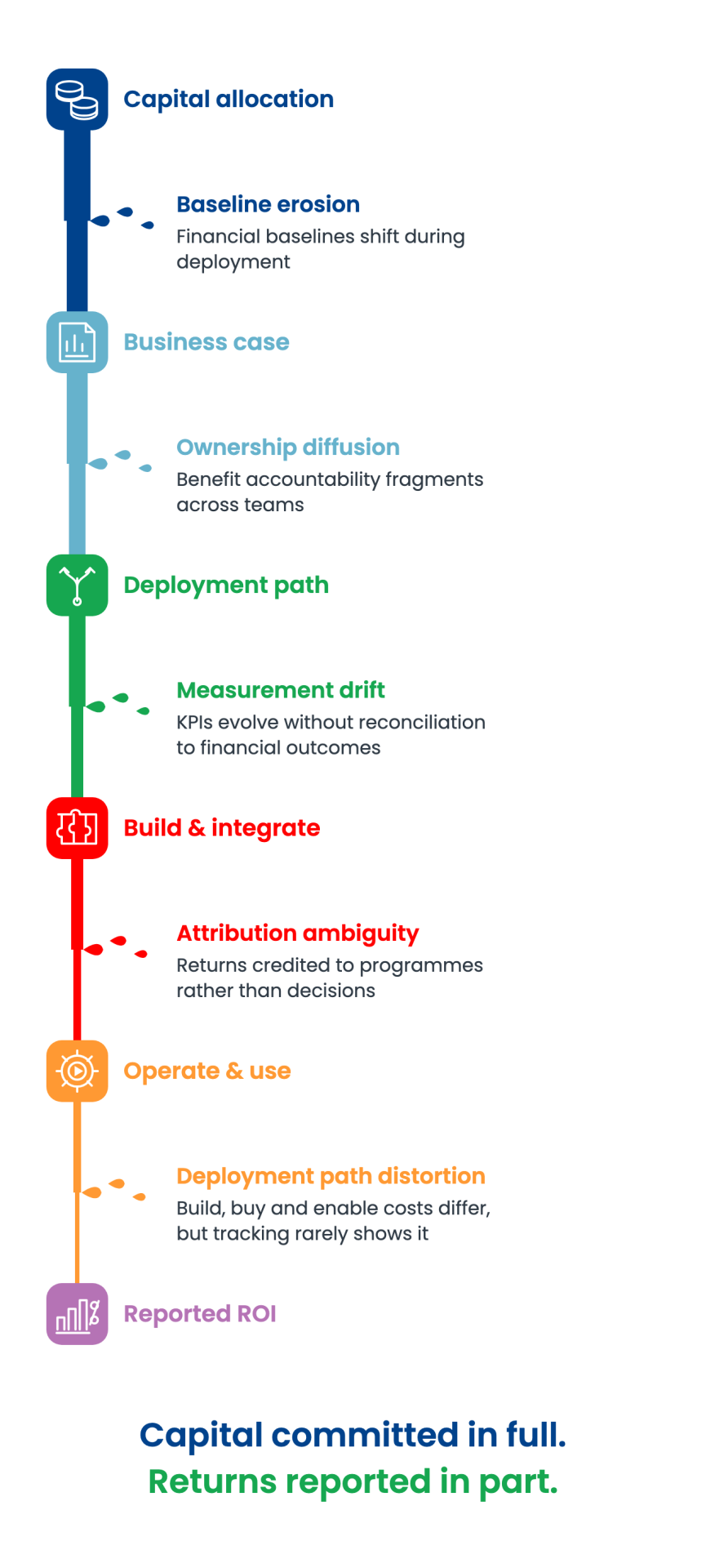
This flow illustrates how capital deployed into AI initiatives moves from allocation to reported return, and where capital integrity most commonly weakens along the way.
The greater risk lies after investment approval, in the gradual erosion of baseline stability, ownership clarity, measurement discipline, attribution precision, and deployment-path visibility once initiatives go live.
Capital discipline therefore depends on structural integrity across the whole flow, and not only on the strength of the business case.
Baseline Erosion
Return figures depend on stable baselines.
During transformation:
• cost structures shift
• volumes change
• operating models evolve
If baselines move silently, reported ROI becomes difficult to validate.
Ownership Diffusion
AI benefits often span many functions.
Without named executive ownership:
• accountability weakens
• benefit tracking fragments
• underperformance becomes unclear
Return without a clear owner rarely stays disciplined.
Measurement Drift
AI value depends on model performance, adoption and behavioural change.
Over time:
• metrics evolve
• assumptions soften
• proxy measures replace the original value logic
Measurement drift weakens capital credibility.
Attribution Ambiguity
AI initiatives rarely operate in isolation.
When several changes happen at once:
• revenue uplift is hard to isolate
• cost savings overlap across programmes
• benefits are double-counted or diluted
Without decision-level attribution, ROI becomes narrative.
Deployment Path Distortion
AI investments follow different deployment paths:
• build internally
• buy external platforms
• switch on AI features in existing third-party software
• embed within broader transformation
Each path carries its own cost structure, risk profile and time to value.
If tracking after deployment does not reflect these differences, reported ROI is misleading by design.
These leakage points are structural design weaknesses in how capital is tracked.
Without a system that protects baseline integrity, ownership clarity, measurement discipline, attribution and deployment-path visibility, capital turns into activity rather than compounding enterprise value.
The Structural Conditions for Realised Return
Capital discipline in AI-enabled enterprises depends less on better dashboards than on whether four structural conditions are designed into how capital flows from allocation to live use.
Where these conditions are in place, return is measurable, attributable and defensible. Where they are missing, ROI becomes narrative.
These conditions belong in the operating architecture rather than in a governance overlay.
Baseline Integrity
Return figures depend on stable, traceable baselines.
Baselines must be:
• defined before deployment
• reconciled to the general ledger
• locked for the transformation lifecycle, and changed only through formal change control
If performance benchmarks shift silently, reported ROI becomes difficult to validate.
Decision-Level Attribution
Benefits must link to decisions and accountable owners rather than to project completion milestones.
Return integrity requires:
• named executive ownership
• traceable decision impact
• financial links to operational outcomes
Without this, attribution
blurs across programmes.
Continuous Value Measurement
Return must be visible as operations run, not pieced back together at year-end.
Measurement should:
• operate at decision speed
• reconcile operational metrics with financial results
• surface underperformance early
Relying only on periodic reviews weakens capital discipline.
Capital Feedback Loops
Return data from operations must shape future capital allocation.
Compounding requires:
• performance visibility at allocation level
• redeployment discipline
• structured learning across investment cycles
Without feedback, capital repeats mistakes rather than
compounding advantage.
What Traditional ROI Frameworks Miss
Most enterprise ROI frameworks are robust in structure and discipline, and are designed to optimise:
• forecast modelling
• capital approval governance
• post-implementation review
These tools are needed, but in AI-enabled settings they are no longer enough.
They tend to focus on approval and reconciliation rather than on how value behaves once systems are operational.
What is often missing is a built-in way to handle:
• evidence at decision time
• clear ownership at the automation point
• lifecycle value tracking
• deployment-path-aware measurement
AI differs from traditional IT spend.
Its return depends on deployment and also on adoption, behaviour change, model performance and ongoing decision quality.
Without ways to track these shifts, reported ROI risks becoming hindsight rather than continuous evidence.
What Good Looks Like — Compounding Return Architecture
Enterprises that sustain AI return over time design for structural capital integrity instead of relying on episodic ROI validation.
The two models below show the architectural difference.
Episodic ROI Model
Return is checked at set points, measurement is periodic and capital choices are reviewed after results are reported.
• project-based funding cycles
• post-hoc performance measurement
• ROI debates at the review stage
• limited linkage between operational signals and capital reallocation
This model works when change is linear and slow, and it weakens as decisions speed up.
Compounding Capital Model
Return is visible as operations run, evidence is created at the time of each decision and capital allocation adapts to real performance.
• decision-generated evidence
• continuous value measurement
• capital reallocation informed by operational data
• deployment path (Build / Buy / Enable) explicitly modelled in return tracking
Capital compounds when feedback loops are built into the structure.
CFOs who build capital integrity into operations spend less time defending ROI.
Executive Capital Self-Test
These questions test whether capital discipline is built into the structure or rests on a shared narrative.
Capital Traceability
Can we trace return from capital allocation
to decision-level impact?
Accountable Ownership
Are AI benefits tied to named accountable owners, and not just to programme structures?
Baseline Integrity
Do financial baselines remain stable and traceable through transformation?
Continuous Measurement
Is value measured as operations run, or reconstructed after the fact?
Capital Feedback Loop
Does operational return data directly inform future capital reallocation?
Scrutiny Readiness
Would our ROI claims withstand audit or regulatory examination tomorrow?
Closing Reflection — Bringing the Series Together
Across this series, one structural theme emerges: enterprise value does not scale through ambition alone. It scales through design.
Playbook 1 examined confidence: keeping value, accountability and control coherent at decision speed.
Playbook 2 defined the structural operating architecture, the system that connects decisions, data, ownership and measurable outcomes.
This playbook addresses the financial consequence: capital integrity.
Architecture makes value possible,
governance makes it defensible
and capital discipline makes it compound.
When these three conditions operate together, AI investment becomes cumulative rather than episodic.
Without structural capital integrity,
AI risks becoming cost inflation rather than capital advantage.
In AI-enabled enterprises, competitive advantage comes from disciplined, compounding return rather than from experimentation alone.
Executive Playbooks

Executive Playbooks
Board-level playbooks designed to help senior leaders navigate enterprise-wide transformation in AI-enabled environments — examining confidence in value, accountability, governance, and control as organisational speed and complexity increase.
Insights from Data Inc
Ideas. Evidence. Measurable Outcomes.
Explore our latest articles and analyses, from AI and data governance to sustainable transformation.
Stay informed, inspired and ahead with insights that can transform your approach to data leadership.

Envalue™ Now Carries IFRS Standards Inside
A return is only as sound as the investment it is measured against.

Data Inc Joins the Claude Partner Network
London, July 2026 — Data Inc is pleased to announce that it has been selected as a member of the Claude Partner Network, Anthropic’s authorised partner programme for organisations that build Claude into their enterprise products and services. Data Inc joins the...

Transformation Has Always Been the Work
Transformation Has Always Been the Work The pace of change in enterprise technology continues to accelerate. AI is now a central part of that conversation, shaping how organisations think about growth, efficiency and scale. What stays consistent, however, is where...

Data Inc appointed to provide ISAE 3000 assurance for major UK Bank
London, January 2026 — Data Inc has been appointed by a global bank to give independent assurance on the replacement of its client account and asset platform. The work centres on data integrity, proof of customer value and control traceability at every step. The...

Scaling SME Performance through Connected Value Systems
Data democratization is revolutionising how organisations handle information by making data accessible to all employees, not just data analysts. This blog explores how companies like the Royal Bank of Scotland are leveraging this inclusive approach to enhance decision-making and customer experiences. Discover the key strategies for implementing effective data democratization, from adopting advanced analytics tools to ensuring robust data governance, and learn why this shift is essential for any competitive business in the digital age.

The Data Operating Model of Transformation
Data democratization is revolutionising how organisations handle information by making data accessible to all employees, not just data analysts. This blog explores how companies like the Royal Bank of Scotland are leveraging this inclusive approach to enhance decision-making and customer experiences. Discover the key strategies for implementing effective data democratization, from adopting advanced analytics tools to ensuring robust data governance, and learn why this shift is essential for any competitive business in the digital age.