
Envalue™ – The Ontology of Value
Board-grade evidence of what transformation is creating — from investment and adoption to attributable value and return
What did we commit to create?
Which financial, operational, strategic, customer, workforce, resilience or risk outcomes did the investment commit to deliver?
What changed — and why?
Can the evidence show that capability was adopted, work changed and outcomes moved, net of market or other external effects?
What is defensible today?
Which value is evidenced, which is at risk and which cannot yet be supported, and what decision should leadership take now?
A value operating model uses one governed evidence chain to connect investment, delivered capability, adoption, operational outcomes and Finance-validated value, continuously, from business case to executive decision.
A Common Language for Enterprise Value
One shared definition of how investment creates value
The Ontology of Value is a formal, governed representation of how investment creates, protects or erodes value. It defines the objects that matter, how they relate, and the rules that decide whether a value claim is valid.
The Value Operating Model governs that representation, and Envalue™ puts both to work. It connects enterprise data, value calculations, evidence and accountable decisions.
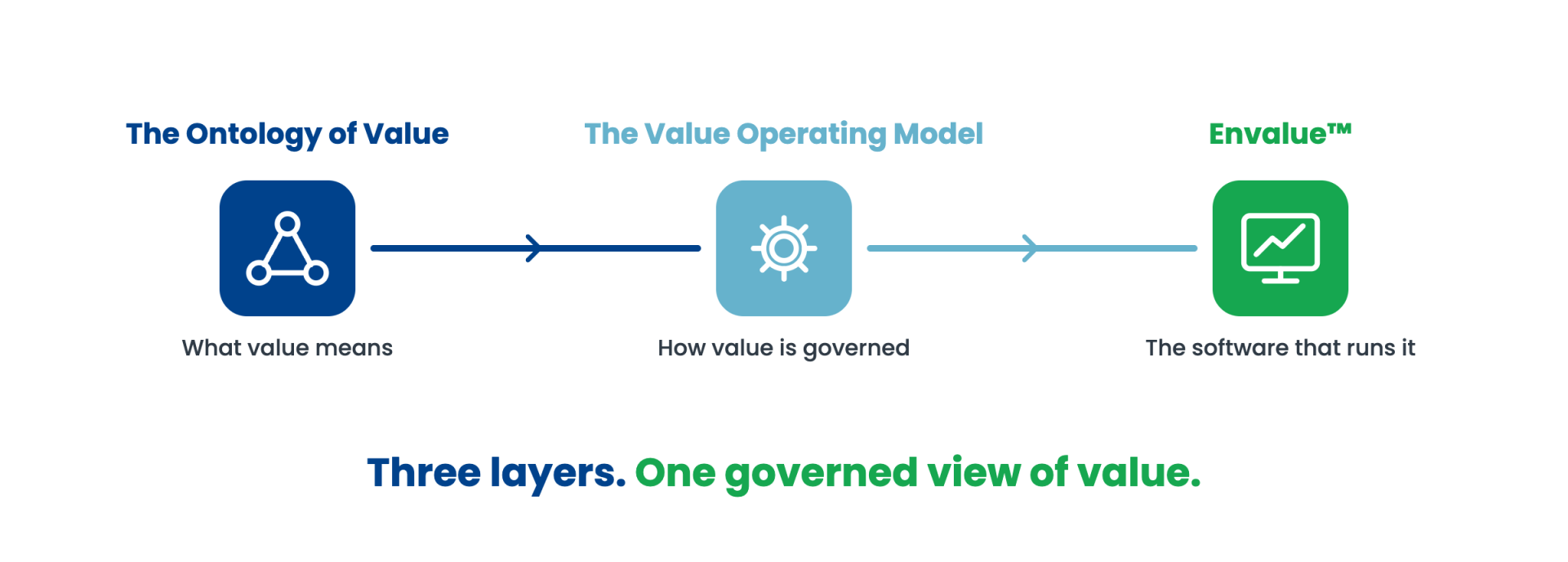
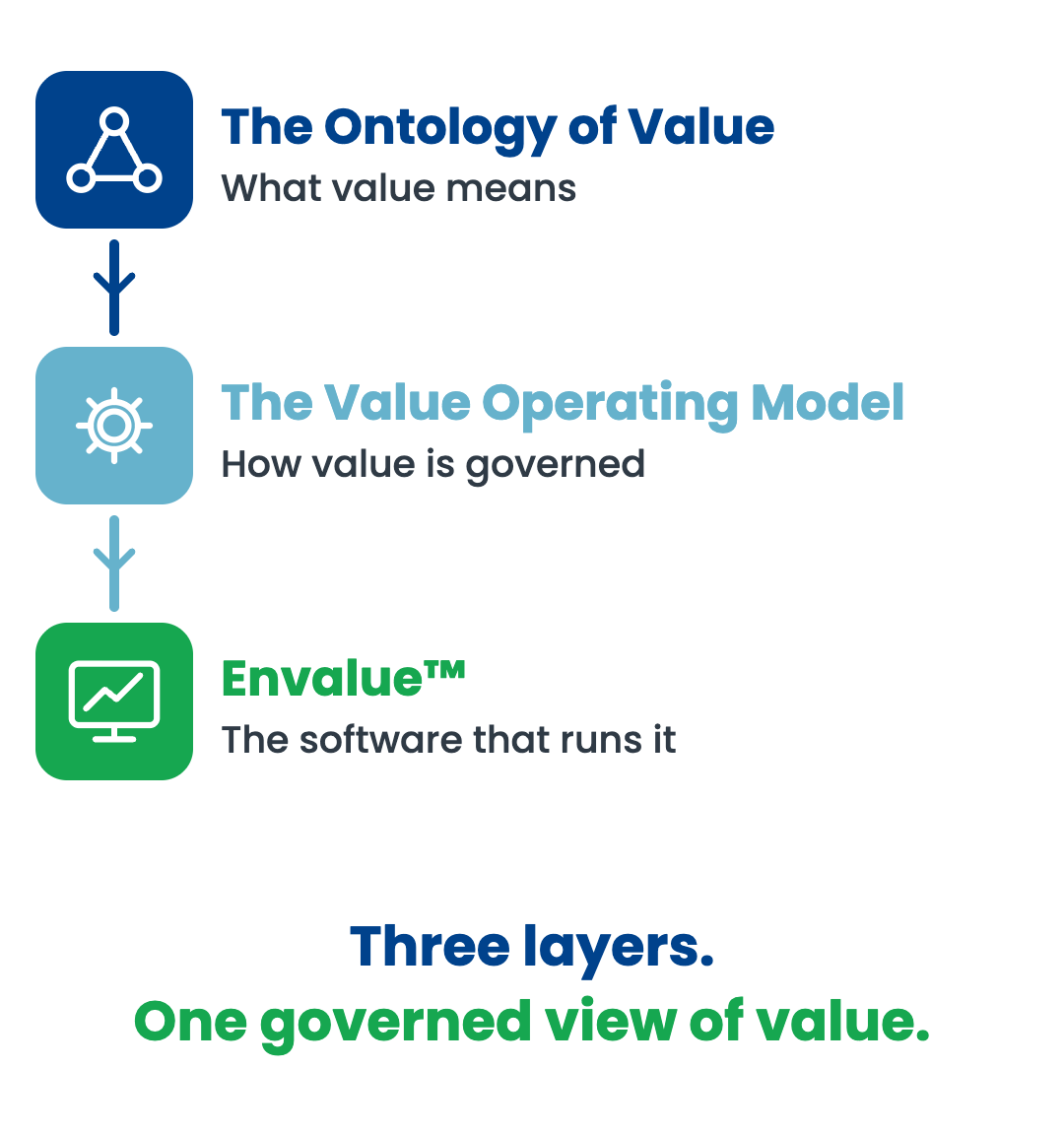
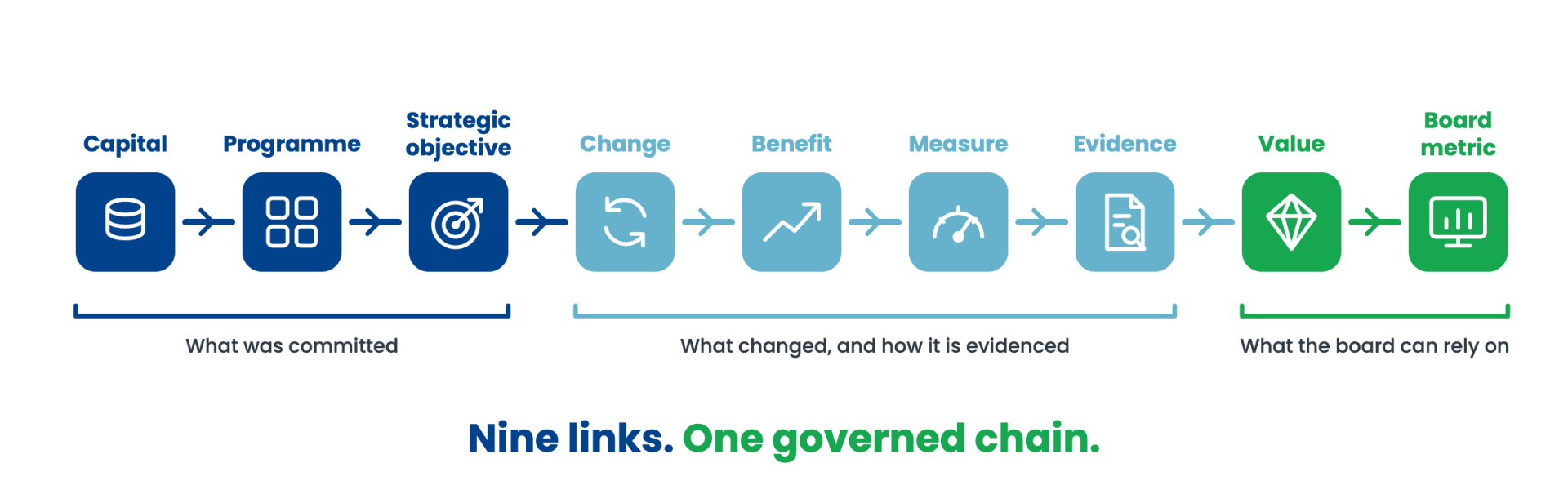
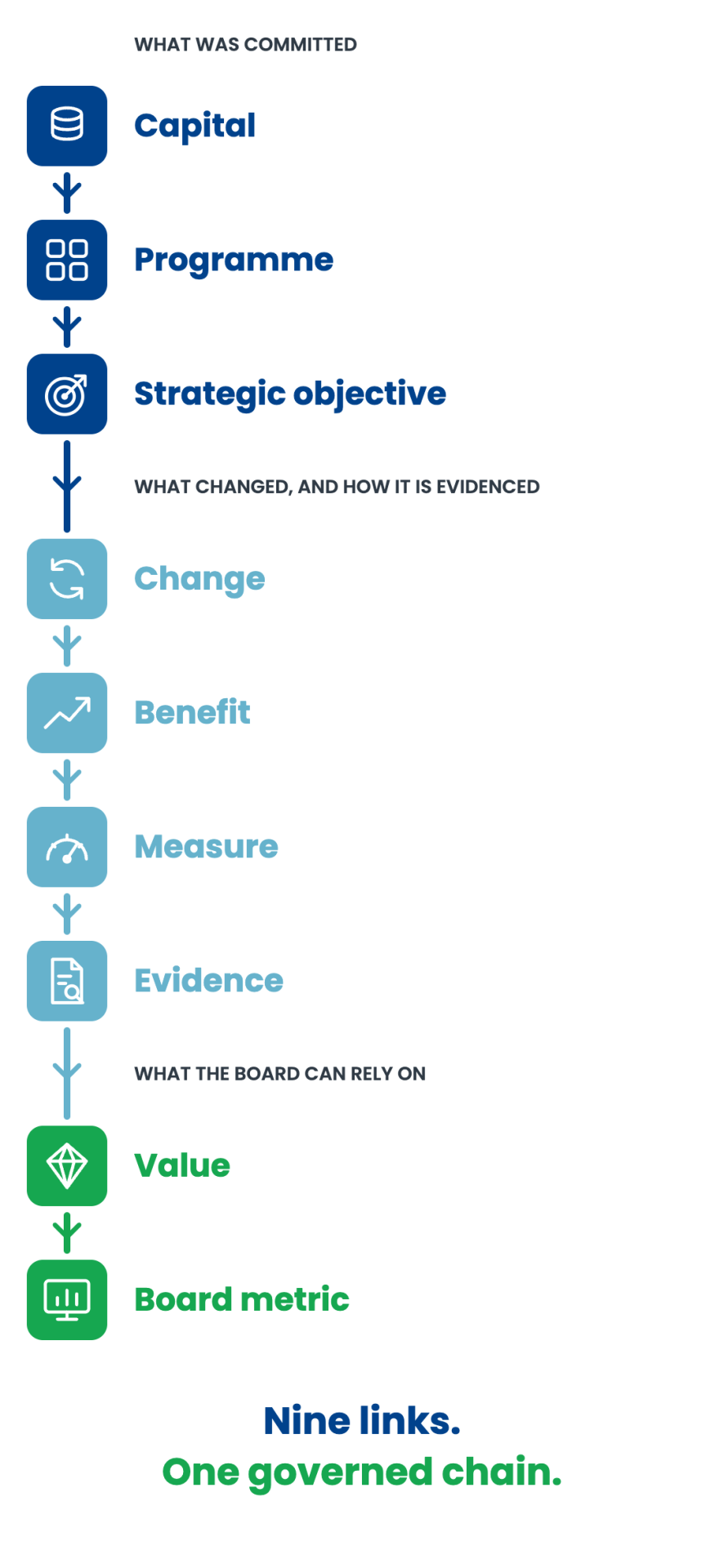
The ontology represents value as nine linked objects, from the capital committed to the board metric it moves.
From Programme Reporting to Value Accountability
A continuously governed position on what transformation is creating
Organisations usually measure spend and delivery more consistently than the value those investments create. AI-enabled change intensifies the problem, because pilot productivity, effective adoption, operating cost and scale economics can move in different directions.
A value operating model establishes a common standard for defining value and evidencing the operating changes that produce it. It distinguishes attributable impact from external movement, so that leadership can act while value can still be protected or recovered. It applies across sectors, transformation portfolios and business-as-usual investment.
What Measuring by Value Actually Means
Five distinct concepts. One governed standard.
Five concepts are distinct. Keeping them distinct prevents spend, delivery activity, operational improvement and financial return from being reported as though they were the same thing.
Cost
The capital, operating expense, people, technology and other resources used.
Activity and output
What is delivered: systems, processes, capabilities and operating-model changes.
Outcome
The measurable change in performance, behaviour, decisions, risk or stakeholder experience.
Business value
The net contribution of outcomes to financial, strategic, customer, workforce, resilience, regulatory or societal goals.
ROI
A financial ratio comparing attributable monetised net benefits with a defined investment over a stated period.
The governing distinction: financial impact is evidence of value and an input to ROI, but it is not ROI by itself. Not every material form of business value can be reduced to a single financial ratio.
The Value Evidence Chain
How investment becomes defensible business value
Value becomes defensible when the causal path and the evidence controls are both visible. The operating chain explains how value is produced; the controls show how confidently it can be claimed.
Investment and cost
The approved commitment and all the resources it will use over its life.
Delivered capability
The technology, process, data or operating capability made available.
Adoption and changed work
Appropriate, proficient and sustained use inside the workflow.
Operational outcome
The measured change in quality, speed, capacity, decisions, experience or risk.
Benefit
The result of that change for the organisation and its stakeholders.
Attributable impact
The portion supported as incremental to the investment rather than external movement.
Value and return
The value position the board is accountable for and, where it applies, ROI, NPV, BCR or payback.
Controls across every link:
Adoption is evidence, not an assumption
Where a benefit depends on adoption, a mature value operating model tracks effective reach, appropriate use, workflow penetration, proficiency and quality, and sustained operation. Usage alone is never treated as value.
For AI-enabled transformation
The cost view can include models and tokens, infrastructure, orchestration, human oversight, exceptions, rework, risk controls, adoption and ongoing AgentOps. Performance connects to value through the cost of each successful, compliant completed outcome, rather than through token volume alone.
Value Measures That Fit the Organisation
A common evidence standard across sectors, strategies and stakeholder outcomes
Each organisation needs one governed value taxonomy, built around its strategy, operating model, stakeholders and reporting obligations. The measures vary; the evidence standard remains consistent.
Growth and financial performance
Revenue, margin, cost, cash flow, productivity, capital efficiency
How operational changes translate into attributable, Finance-reconciled financial effects.
Customer and stakeholder
Retention, satisfaction, accessibility, service quality, outcomes
Whether the change improved experience or outcomes without moving cost or harm elsewhere.
Workforce and operations
Capacity, cycle time, quality, safety, proficiency, exception rates
Whether capability was adopted and changed how work is performed, to the required standard.
Risk, resilience and compliance
Expected loss, control effectiveness, downtime, recovery, regulatory outcomes
How risk reduction protects or enables value after accounting for control cost and residual risk.
The transformation sponsor, Finance, operational owners and other accountable functions agree the taxonomy. It keeps leading indicators, operational outcomes, realised benefits and financial returns apart.
How a Value Operating Model Complements Existing Disciplines
A value-accountability layer connecting delivery, benefits and assurance
A value operating model works alongside established management and assurance disciplines, connecting them through a continuously governed value position.
PROGRAMME MANAGEMENT
PRINCIPAL QUESTION
Is delivery on track?
WHAT IT ADDS
It adds whether value is on track and whether intervention is needed before delivery ends.
BENEFITS MANAGEMENT
PRINCIPAL QUESTION
Are intended outcomes and benefits being realised?
WHAT IT ADDS
It builds source evidence, attribution, adoption and financial reconciliation into the operating cycle.
INDEPENDENT ASSURANCE
PRINCIPAL QUESTION
Can stakeholders rely on the controls and claims?
WHAT IT ADDS
It keeps the evidence record that periodic or continuous assurance can work from.
Many organisations implement benefits management inconsistently or reconstruct evidence late. A value operating model closes that execution gap, while recognised benefits-management practice remains the foundation it builds on.
Evidence by Design
Controls that make value claims traceable, proportionate and defensible
Evidence quality depends on method, controlled data and accountable decisions more than on presentation. Three controls keep the value position defensible.
Baseline and counterfactual integrity
The original baseline is validated, dated and retained. The configured counterfactual accounts proportionately for trends, external changes and what would credibly have happened without the investment.
Attribution method and confidence
Each material claim has an agreed attribution method, external-factor treatment and evidence-confidence level. Association is distinguished from causally supported impact.
Financial reconciliation and sign-off
Reconciliation establishes where financial effects are recorded, applies anti-double-counting controls and records accountable review. It validates the financial mapping; attribution is established by the attribution method.
Every baseline decision, source record, attribution judgement, reforecast and sign-off is retained in a timestamped audit trail. That record establishes which value can be defensibly claimed and used in decisions.
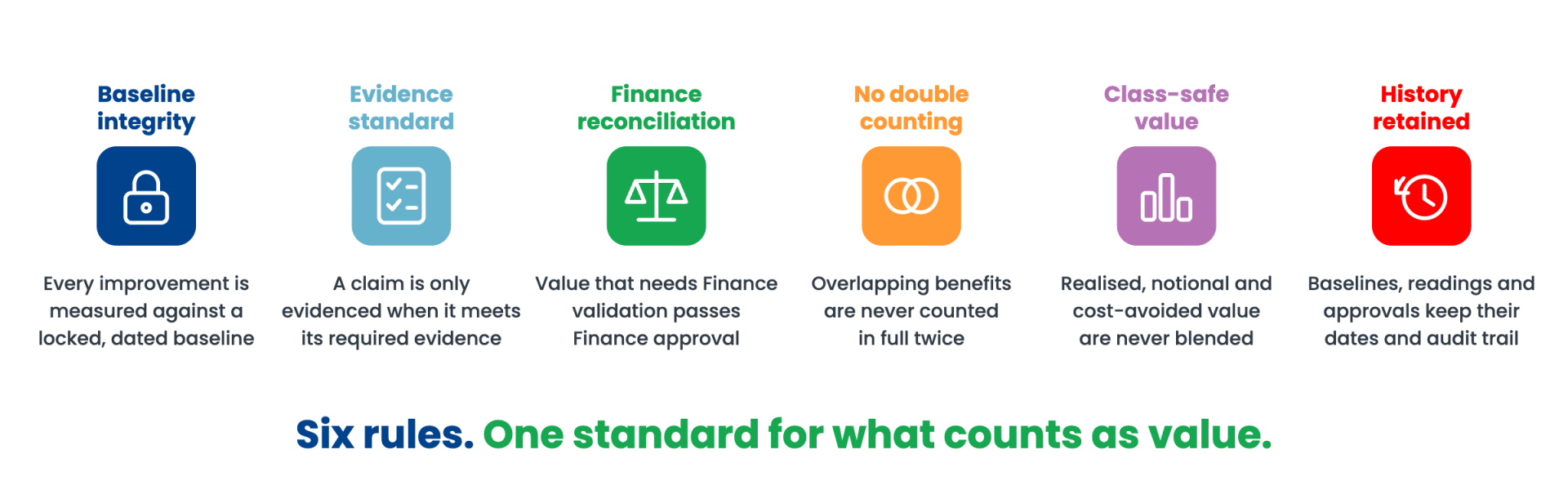
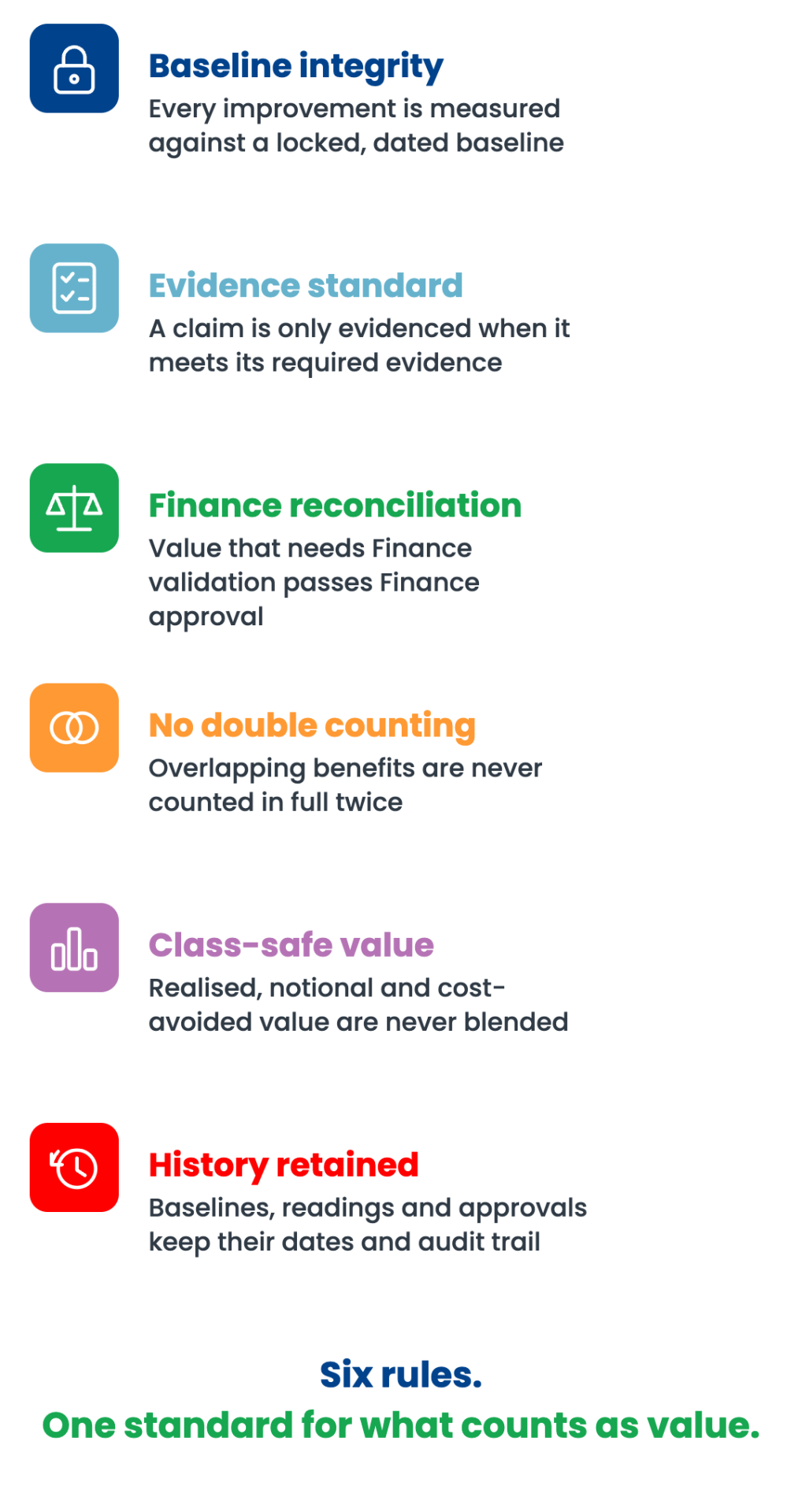
Within the ontology, these controls become six rules that decide what counts as value.
When Value Trajectories Shift
Continuous evidence that turns visibility into executive control
Continuous evidence matters because value does not move in a straight line. A value operating model links leading causal indicators to realised outcomes, so leadership can respond before deterioration reaches the board metrics.
Value-at-Risk alerts
Material deviation from the expected benefit trajectory triggers review while the benefit can still be protected, redesigned or retired. These alerts measure benefit erosion and are distinct from market VaR.
Attribution and reforecasting
External events, parallel initiatives and updated evidence are reflected transparently in the attributable range and forward value trajectory.
Value durability
Effective reach, appropriate use, workflow penetration, proficiency, quality, exception rates and sustainment show whether an operational benefit is likely to last.
How risk changes expected value
Risk-adjusted net value = expected benefits − lifecycle costs
Risk reduction protects or enables value when it raises the probability or durability of beneficial outcomes, reduces expected loss or opens options that would otherwise remain unavailable. The cost and operational constraints of the control are also included. Risk and value are related, but they are measured separately.
The Economic Value of Earlier Evidence
Intervene, reallocate or retire claims while decisions can still change
Earlier evidence has economic value when it changes a decision. A value operating model makes three effects visible.
Earlier intervention
Protect or recover benefits while adoption, workflow design, delivery scope or operating performance can still be put right.
Better capital allocation
Direct resources towards evidenced value, challenge weak claims and stop carrying benefits that are no longer supportable.
Lower evidence overhead
Replace rebuilding evidence after the fact with an up-to-date record. It supports executive, Finance, assurance and regulatory discussions.
Illustrative case, not a promised return: on a £500 million approved benefit portfolio, preventing 1% of otherwise probable erosion would protect £5 million of value. The actual return depends on the counterfactual erosion, the attributable effect of the intervention, timing and full cost.
A bounded Value-at-Risk assessment can establish the starting position: what is already evidenced, what is at risk and what cannot yet be supported on current evidence. Leadership then decides what further intervention is justified.
See Envalue™ in Action
Live and Demonstrable Today
Prioritise
Which proposed commitments deserve capital — and which need more evidence before funding is committed?
Steer
Which approved commitments are creating value and which are eroding? Where should leaders intervene or reallocate before value is lost?
Account
Which outcomes can leaders defend to the board, investors and the market — and which must be qualified or left out of the narrative?
Envalue™ governs the full chain, from the investment decision to an outcome that is defensible to stakeholders.
Live access can be arranged for qualified prospects.
Executive Playbooks

Executive Playbooks
Board-level playbooks designed to help senior leaders navigate enterprise-wide transformation in AI-enabled environments — examining confidence in value, accountability, governance, and control as organisational speed and complexity increase.
Insights from Data Inc
Ideas. Evidence. Measurable Outcomes.
Explore our latest articles and analyses — from cutting-edge AI and data governance to sustainable transformation.
Stay informed, inspired and ahead with insights that can transform your approach to data leadership.
Envalue™ Now Carries IFRS Standards Inside
A return is only as sound as the investment it is measured against.

Data Inc Joins the Claude Partner Network
London, July 2026 — Data Inc is pleased to announce that it has been selected as a member of the Claude Partner Network, Anthropic’s authorised partner programme for organisations that build Claude into their enterprise products and services. Data Inc joins the...

Transformation Has Always Been the Work
Transformation Has Always Been the Work The pace of change in enterprise technology continues to accelerate. AI is now a central part of that conversation, shaping how organisations think about growth, efficiency and scale. What stays consistent, however, is where...

Data Inc appointed to provide ISAE 3000 assurance for major UK Bank
London, January 2026 — Data Inc has been appointed by a global bank to give independent assurance on the replacement of its client account and asset platform. The work centres on data integrity, proof of customer value and control traceability at every step. The...

Scaling SME Performance through Connected Value Systems
Data democratization is revolutionising how organisations handle information by making data accessible to all employees, not just data analysts. This blog explores how companies like the Royal Bank of Scotland are leveraging this inclusive approach to enhance decision-making and customer experiences. Discover the key strategies for implementing effective data democratization, from adopting advanced analytics tools to ensuring robust data governance, and learn why this shift is essential for any competitive business in the digital age.

The Data Operating Model of Transformation
Data democratization is revolutionising how organisations handle information by making data accessible to all employees, not just data analysts. This blog explores how companies like the Royal Bank of Scotland are leveraging this inclusive approach to enhance decision-making and customer experiences. Discover the key strategies for implementing effective data democratization, from adopting advanced analytics tools to ensuring robust data governance, and learn why this shift is essential for any competitive business in the digital age.