
Resilience as a System Property
Designing Data-Driven Controls for AI-Enabled Enterprises
Executive Introduction
Most enterprises think they are resilient because they have
incident response plans,
recovery time objectives,
redundancy frameworks,
and regulatory attestations.
These tools matter.
Yet when disruption hits an AI-enabled operation:
• data pipelines stall
• automation loops amplify errors
• model dependencies cascade across systems
• cost controls conflict with continuity commitments
The issue is seldom a lack of planning.
The issue is that resilience is not built into how
decisions work.
As AI moves into core work such as service routing, operational optimisation, customer fulfilment and the supply chain, resilience shifts from a recovery capability to a
system property.
Operational resilience is not proven by documentation alone.
It is also shown by whether systems:
• degrade gracefully under stress
• contain failure before it spreads
• keep services running when under strain
• send live signals when control limits are breached
Resilience depends on architecture as well as recovery plans.
This playbook sets out the core conditions for designing
data-driven controls that protect continuity, stability and service integrity in AI-enabled enterprises.
Why This Matters Now
AI changes the shape of how the business runs.
It adds to:
• interdependencies
• system coupling
• automation autonomy
• data velocity
In tightly linked systems, failure seldom shows up as a clear outage.
Instead, it shows up as:
• silent data degradation
• SLA breaches with no alert raised
• cost spikes with no rule to catch them
• shifts in model behaviour with no formal breach of governance
None of these is a catastrophic event on its own.
Each is a control weakness that builds up quietly.
Older resilience models were built for:
• system failure
• loss of infrastructure
• disaster recovery cases
AI-enabled enterprises face a different test.
They must find, contain and fix disruption
before the service can be seen to break.
Resilience must become visible and largely automatic, with clear human accountability for recovery.
Where Operational Resilience Breaks Down
Operational resilience seldom fails at the planning stage.
It weakens within live AI-enabled operating flows, where data, automation, cost optimisation and control meet all the time.
The structural vulnerabilities can be foreseen.
Data Source → Processing → Model → Decision → Execution → Monitoring → Reporting
Across this flow, five structural failure points commonly appear:
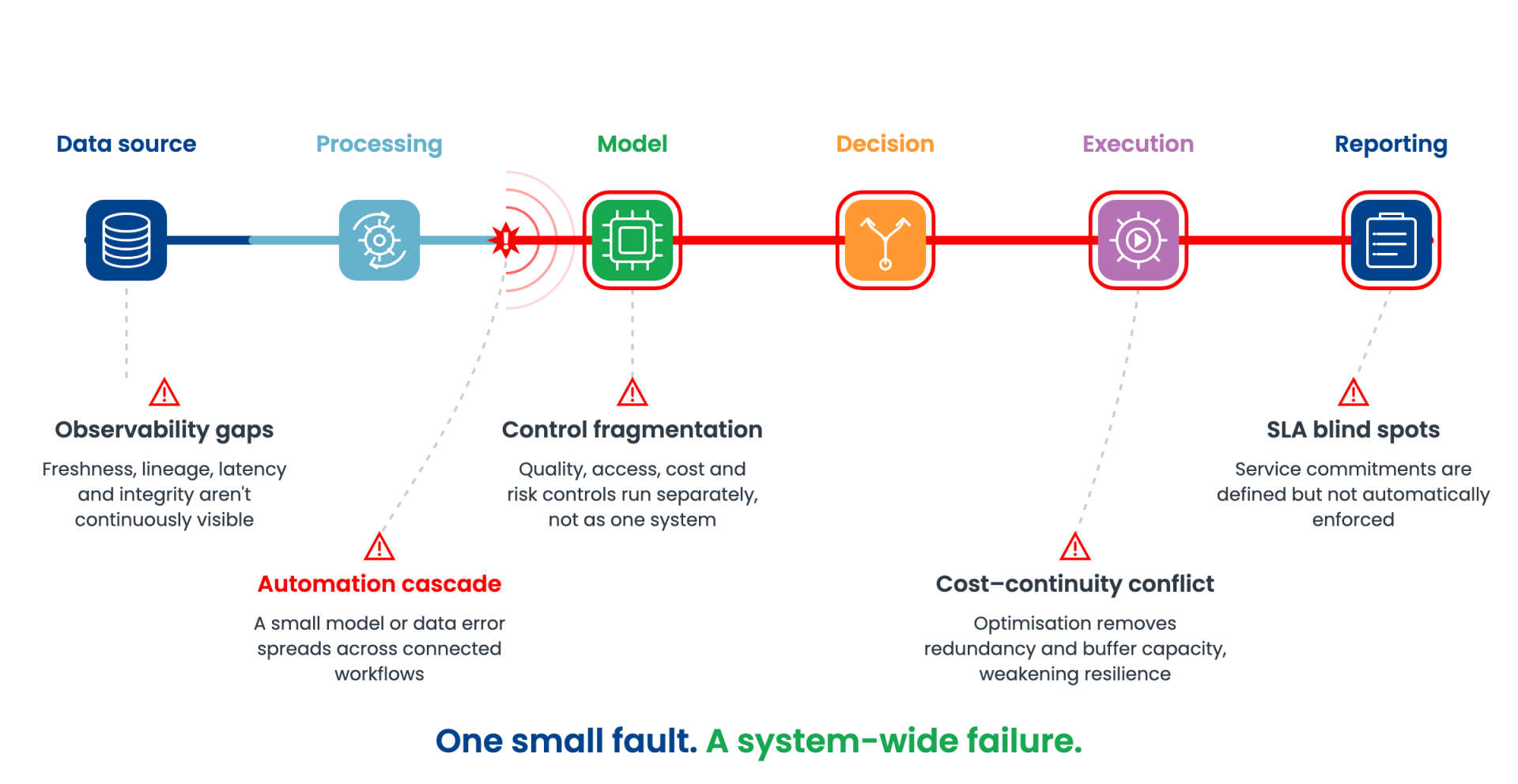
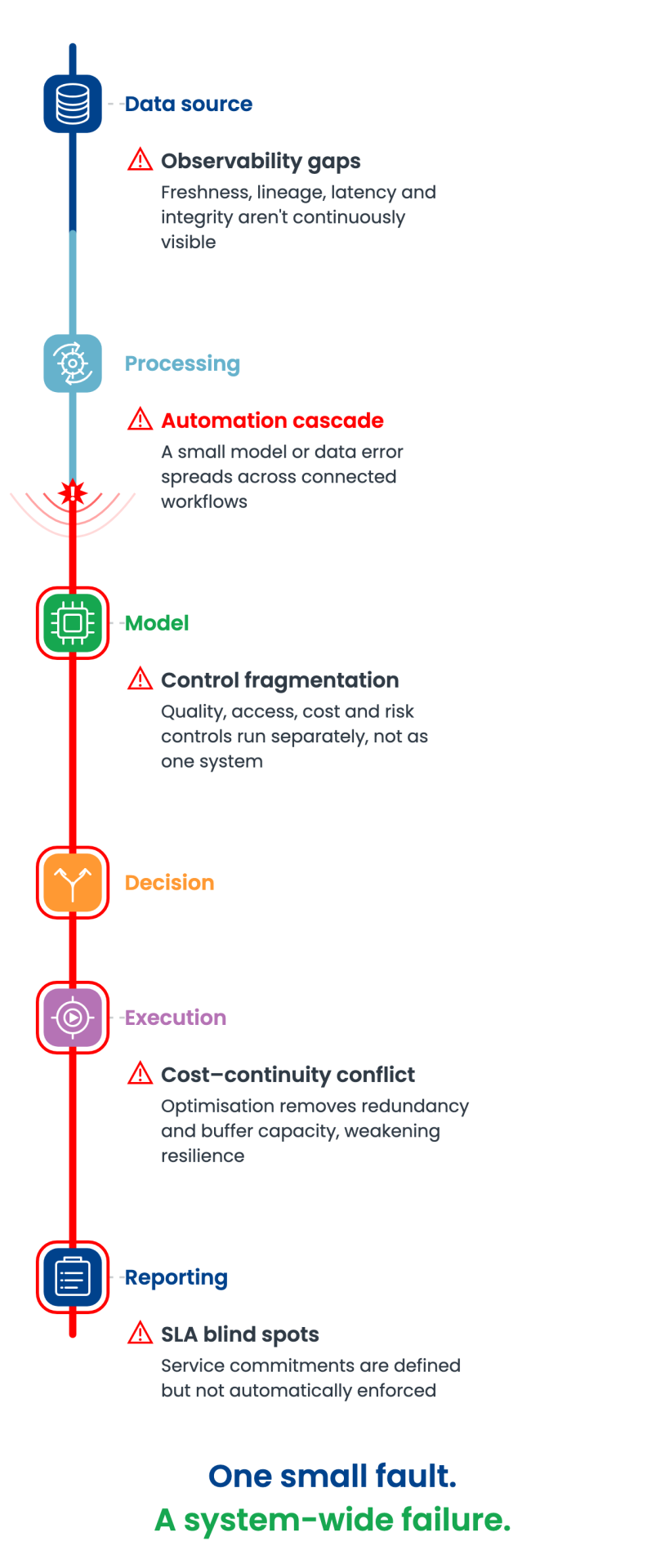
Observability Gaps
Data freshness, lineage, and integrity are not in view at all times, which leaves blind spots before failure shows.
Control Fragmentation
Quality, access, cost and risk controls work as
separate layers rather than as one linked system.
SLA Blind Spots
Service commitments are defined but not enforced or monitored live by the system.
Automation Cascade
A small model or data error can spread across interconnected workflows, amplifying the operational impact.
Cost–Continuity Conflict
Cloud optimisation and cost scripts can, by accident, weaken
service resilience if they are not built to fit with it.
These failure modes seldom show up as outages.
They show up through drift, latency and silent degradation.
The Structural Conditions for Adaptive Resilience
Resilience is not the absence of disruption.
It is the built-in ability to adapt, absorb and recover without harm to decision integrity.
In AI-enabled settings, adaptive resilience rests on five core conditions:
System Observability
Data freshness, lineage, latency, and drift can be seen at all times, rather than guessed at after disruption.
Control-in-Motion
Controls are built into operational workflows
and run at the point of decision rather than added on after the fact.
SLA Enforcement
Service commitments are automatically monitored
and escalations are triggered when limits are breached, rather than found later in a report.
Human–Machine Recovery
AI-assisted detection is paired with explicit human override
at set points for escalation, which keeps accountability in place under stress.
Cost-Aware Resilience
Cloud optimisation and cost controls are in line with
continuity objectives, so that efficiency does not wear down stable operations.
What Traditional Resilience Frameworks Miss
Older resilience frameworks were built around
recovery planning,
impact tolerances,
scenario testing,
and oversight by committee.
These practices are still needed.
But they are mostly built around:
• set recovery steps
• periodic validation cycles
• manual routes for escalation
They seldom build in:
• data observability as a core control
• automation-aware SLA governance
• cost-integrated resilience logic
• constant failure detection
AI raises risk, and it can also make operations fragile.
It adds to operational fragility wherever resilience is not built into how systems run.
What Good Looks Like — Resilience as a System Property
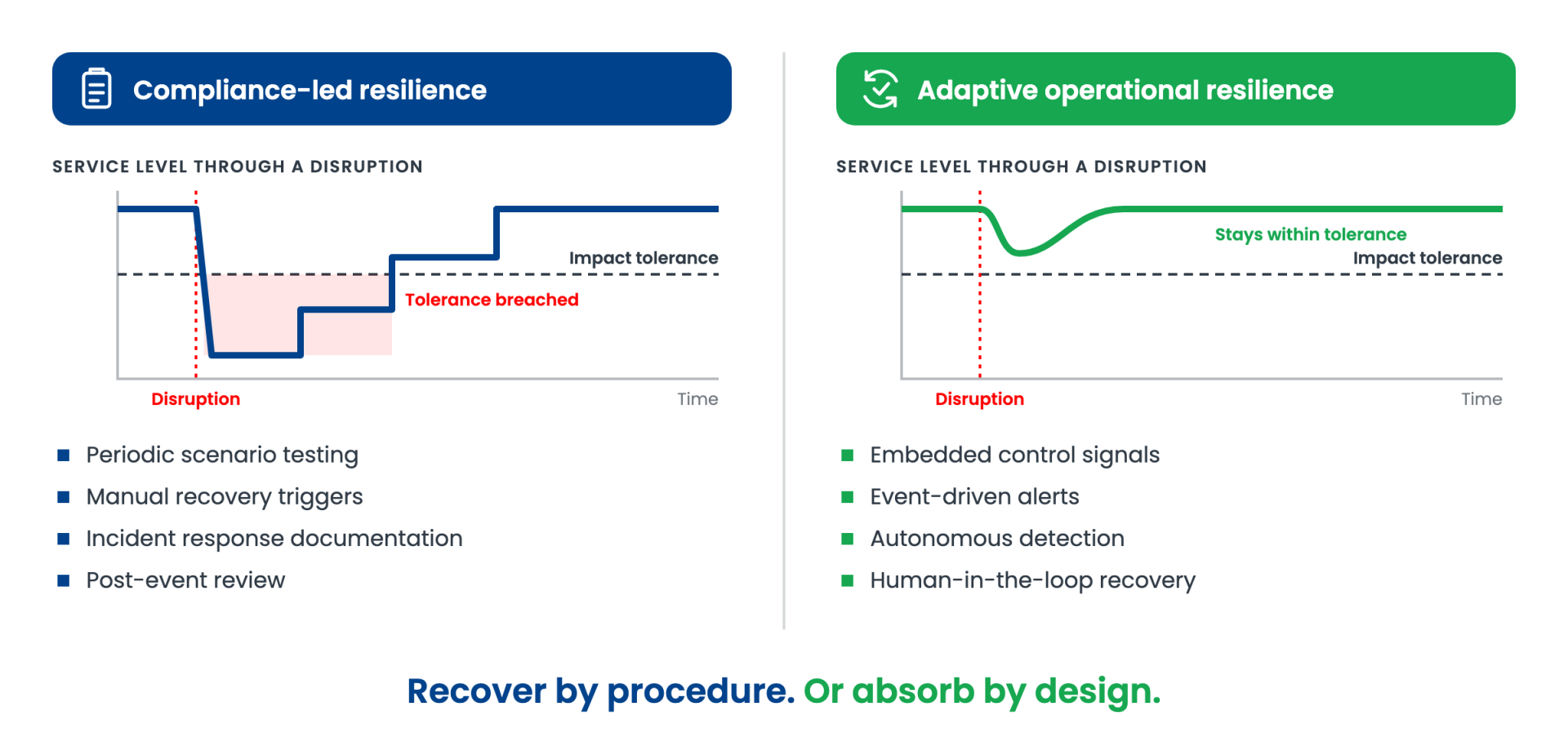
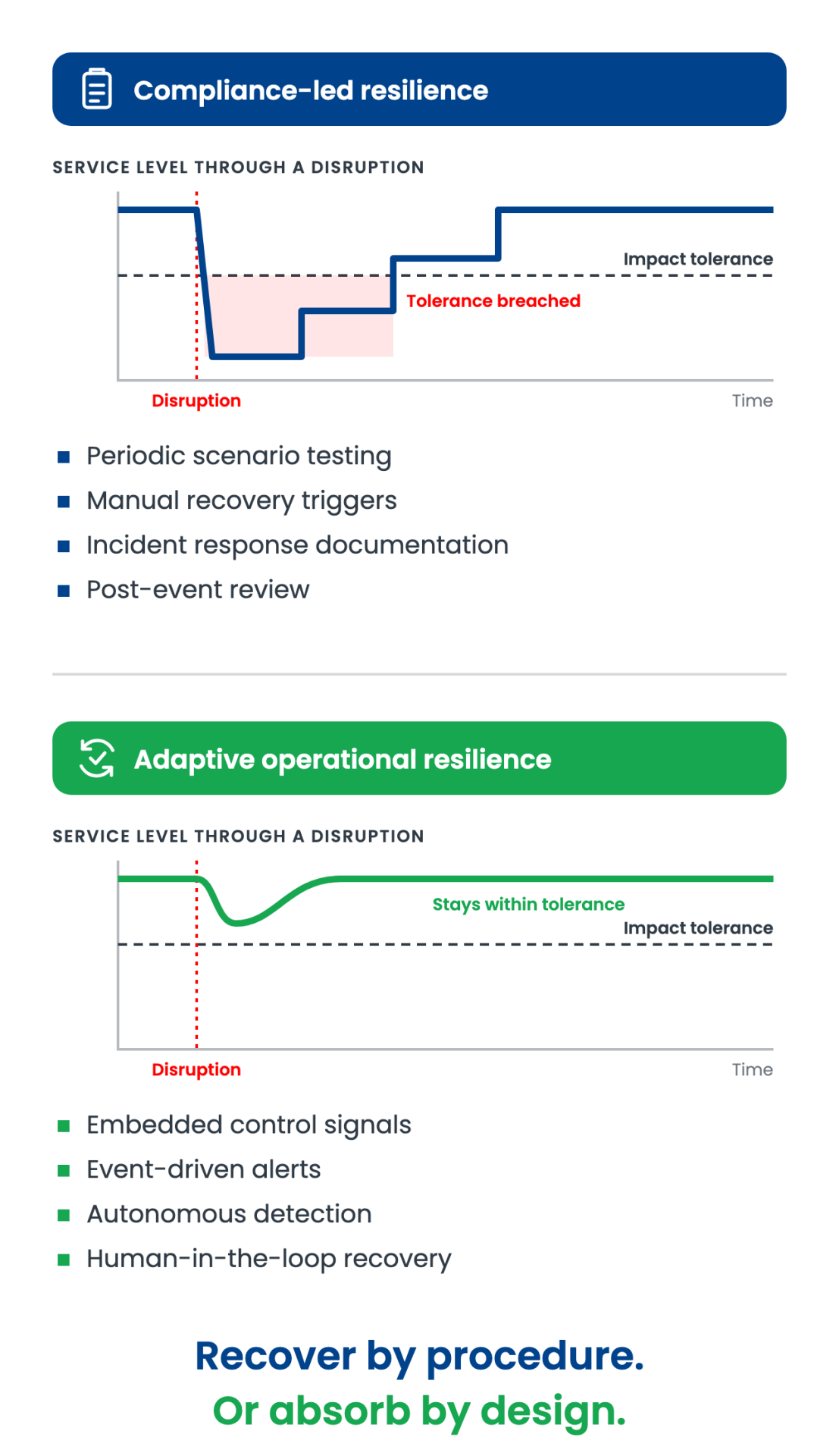
Compliance-Led Resilience
• Scenario tests from time to time
• Manual recovery triggers
• Incident response documents
• Review after the event
Adaptive Operational Resilience
• Control signals built in
• Event-driven alerts
• Autonomous detection
• Human-in-the-loop recovery
• Continuous learning loops
Executive Resilience Self-Test
Continuous Data Visibility
Can we see data freshness, lineage, and SLA health at all times, and not just in review cycles?
Pre-Impact Control Detection
Are control failures found before customers feel the impact?
Explicit Escalation Boundaries
Do automated workflows have explicit escalation boundaries and triggers for a human to step in?
Cost–Resilience Alignment
Is resilience linked with cost optimisation, or working in structural tension with it?
Cascading Failure Simulation
Can we model cascading failure across interconnected systems before disruption strikes?
Regulatory Stress Confidence
Could we show that service continuity holds within impact tolerance under regulatory stress scenarios?
Closing — Completing the Enterprise Architecture
Resilience is now more than a recovery capability.
It has become an operational system property.
As AI adds to interdependency,
automation autonomy,
and data velocity,
failure spreads in new ways.
Outages are visible; structural fragility is not.
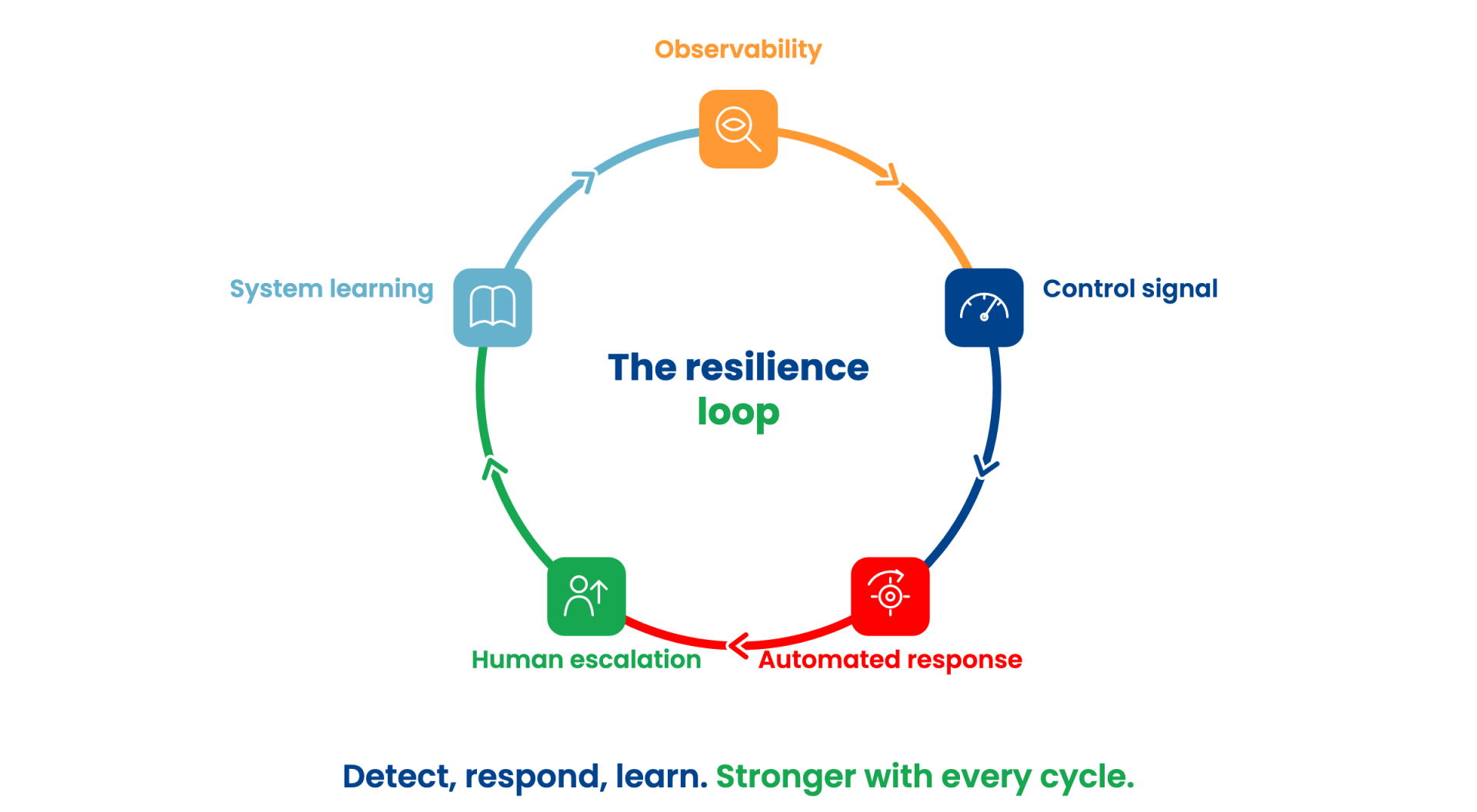
Observability must be constant.
Controls must work in motion.
Escalation boundaries must be explicit.
Cost optimisation must align with continuity.
When resilience is built into how decisions run,
systems adapt before failure cascades.
In AI-enabled enterprises, resilience is more than a compliance requirement.
It decides whether scale strengthens the system or destabilises it.
Executive Playbooks

Executive Playbooks
Board-level playbooks designed to help senior leaders navigate enterprise-wide transformation in AI-enabled environments, examining confidence in value, accountability, governance and control as organisational speed and complexity increase.
Insights from Data Inc
Ideas. Evidence. Measurable Outcomes.
Explore our latest articles and analyses, from AI and data governance to sustainable transformation.
Stay informed, inspired and ahead with insights that can transform your approach to data leadership.

Envalue™ Now Carries IFRS Standards Inside
A return is only as sound as the investment it is measured against.

Data Inc Joins the Claude Partner Network
London, July 2026 — Data Inc is pleased to announce that it has been selected as a member of the Claude Partner Network, Anthropic’s authorised partner programme for organisations that build Claude into their enterprise products and services. Data Inc joins the...

Transformation Has Always Been the Work
Transformation Has Always Been the Work The pace of change in enterprise technology continues to accelerate. AI is now a central part of that conversation, shaping how organisations think about growth, efficiency and scale. What stays consistent, however, is where...

Data Inc appointed to provide ISAE 3000 assurance for major UK Bank
London, January 2026 — Data Inc has been appointed by a global bank to give independent assurance on the replacement of its client account and asset platform. The work centres on data integrity, proof of customer value and control traceability at every step. The...

Scaling SME Performance through Connected Value Systems
Data democratization is revolutionising how organisations handle information by making data accessible to all employees, not just data analysts. This blog explores how companies like the Royal Bank of Scotland are leveraging this inclusive approach to enhance decision-making and customer experiences. Discover the key strategies for implementing effective data democratization, from adopting advanced analytics tools to ensuring robust data governance, and learn why this shift is essential for any competitive business in the digital age.

The Data Operating Model of Transformation
Data democratization is revolutionising how organisations handle information by making data accessible to all employees, not just data analysts. This blog explores how companies like the Royal Bank of Scotland are leveraging this inclusive approach to enhance decision-making and customer experiences. Discover the key strategies for implementing effective data democratization, from adopting advanced analytics tools to ensuring robust data governance, and learn why this shift is essential for any competitive business in the digital age.