
Confidence in AI-Enabled Enterprises
Assured Value, Accountability and Control

Executive Introduction
Boards today are not short of ambition, investment or AI capability. What many increasingly lack is confidence.
They want confidence that AI-enabled transformation is delivering measurable value, that accountability stays clear as decisions become automated or augmented, and that high-velocity decisions can still be explained, evidenced and governed.
As AI becomes embedded in core operations, from pricing and underwriting to customer interaction and forecasting, enterprise change becomes continuous rather than episodic. Value is created, adjusted or eroded in real time.
Yet many governance, assurance and reporting mechanisms were designed for slower, project-based change, when people made the decisions, oversight was periodic and evidence could be assembled afterwards.
This rarely leads to visible failure. More often, it leads to structural uncertainty.
Boards are unsure whether value is realised or merely modelled, who owns automated or distributed decisions, and whether control frameworks keep pace with adaptive systems.
That uncertainty increasingly holds back enterprise momentum.
Why This Matters Now
AI exposes gaps in enterprise design.
When data-driven decision systems scale across functions, small misalignments between strategy, operating model, governance and assurance compound quickly. Oversight becomes harder, evidence fragments and accountability blurs.
In AI-enabled enterprises, confidence cannot be assumed as a by-product of delivery. It must be built into how the organisation:
• defines and tracks value
• assigns decision ownership and evidences it
• applies proportionate governance
• generates evidence in real time
Enterprises that design for this move decisively, while those that do not slow down under scrutiny.
Scale and speed are not the only forces shaping this design task. Emerging AI governance standards and regulatory expectations matter too, from the EU AI Act to the NIST AI Risk Management Framework and sector-specific supervisory scrutiny.
How to Use This Playbook
This playbook is a board-level diagnostic and design lens.
It helps senior leaders:
• identify where AI-enabled change is creating structural gaps in confidence
• understand why traditional governance models struggle with distributed decision systems
• redesign enterprise mechanisms to restore assurance without slowing execution
Its aim is to sharpen the questions you ask at your next Board or Executive Committee discussion.
Where Confidence Breaks Down
The Four Pressure Points Boards Underestimate
Confidence rarely fails through a single incident. It weakens as AI-enabled decisions scale faster than the structures used to oversee them.
As automation expands into pricing, credit, operational prioritisation, customer interaction and forecasting, pressure builds in predictable places.
In AI-enabled enterprises, this pressure gathers around four structural gaps. Each one is manageable alone, but together they destabilise the enterprise.
They stem from operating models that were never designed for continuous, data-driven decision-making, rather than from a lack of ambition or capability.
The four pressure points are:
• Value without credibility
• Accountability without clarity
• Governance that can’t keep pace
• Delivery without coherence
As AI adoption accelerates, these gaps reinforce one another. The model below shows how misalignment between value, accountability, governance, and delivery creates systemic fragility.
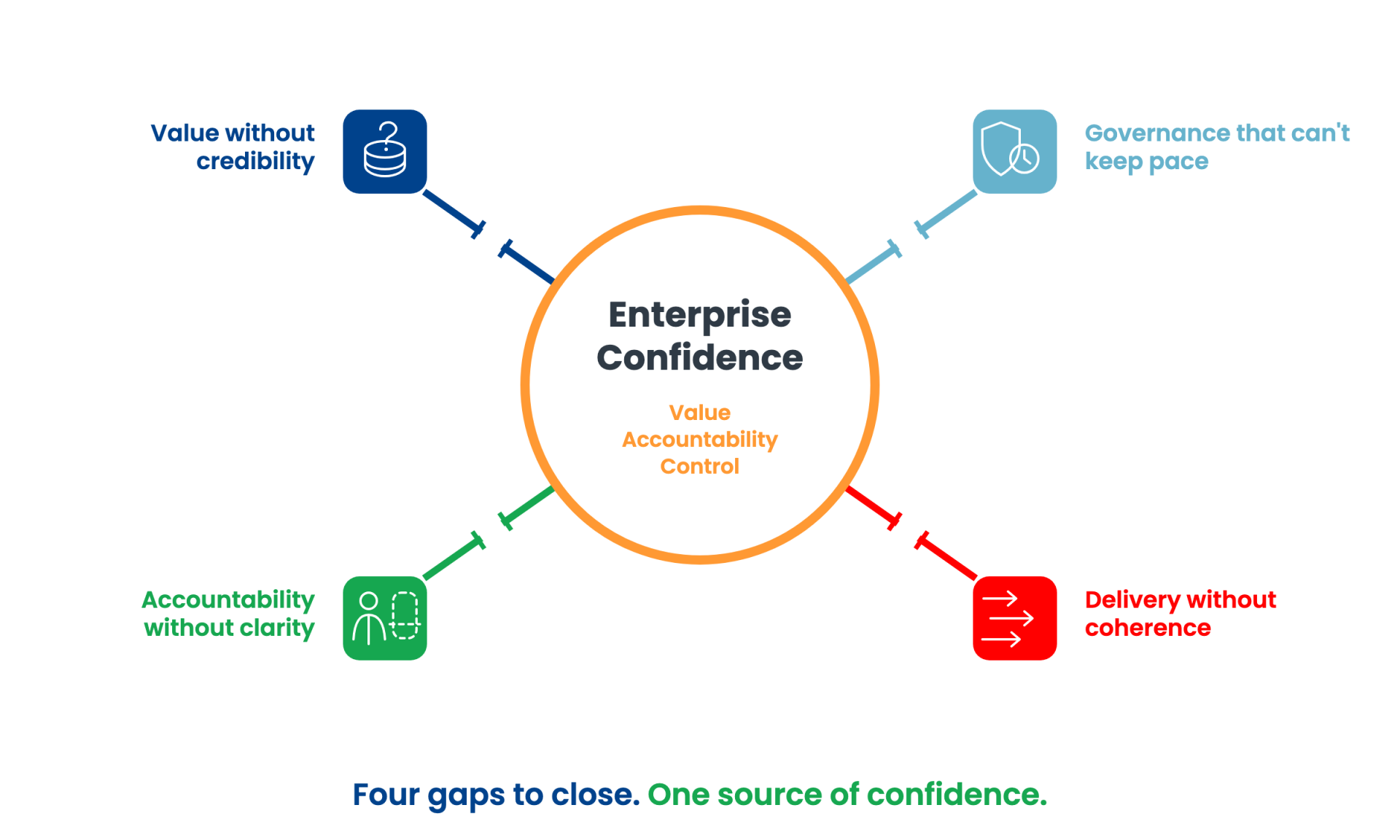
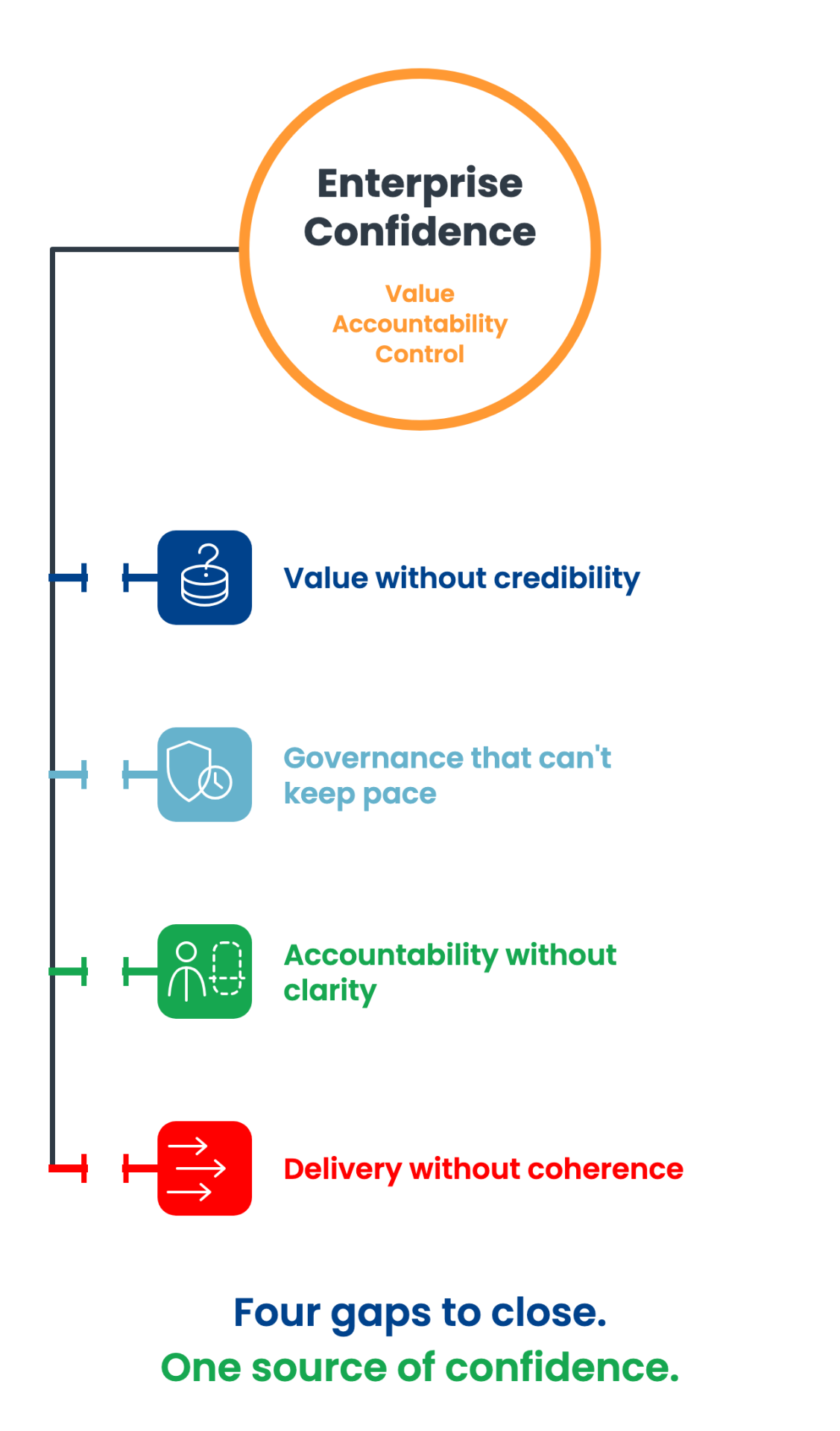
It is a structural view of where confidence becomes exposed as AI-driven decisions scale, rather than a maturity model or a defined target state.
It highlights how gaps in value traceability, accountability clarity, governance responsiveness and delivery coherence reinforce one another.
Addressing any one dimension in isolation, such as tightening governance without clarifying decision ownership, rarely restores enterprise confidence.
Pressure Point 1
Value Without Credibility
Most organisations can articulate the value a transformation is expected to deliver. Far fewer can evidence value as it is realised.
Value is often tracked through activity:
• milestones achieved
• outputs delivered
• progress reported
These are delivery indicators rather than verified value.
Boards must distinguish:
• value realised vs value forecast
• outcomes achieved vs activity completed
When value definition, ownership and measurement are not embedded in the operating model, credibility weakens. This is especially true of AI-enabled initiatives, where benefits depend on model performance, adoption and sustained impact.
Without clear evidence, scrutiny increases and momentum slows.
Pressure Point 2
Accountability Without Clarity
As AI becomes embedded in operational decision-making, traditional accountability models are stretched.
Decisions that were once clearly owned are now automated, AI assisted or distributed across human–machine workflows.
In many organisations, accountability exists but is not operationally explicit.
Common gaps include:
• unclear ownership of model-driven outcomes
• roles defined in policy without decision-level evidence
• shared responsibility without named decision accountability
As AI decisions affect pricing, credit, eligibility, customer experience or risk exposure, Boards must be able to answer:
• who owns the outcome
• where human override applies
• how accountability is evidenced at decision time
Without this clarity, accountability becomes difficult to demonstrate under regulatory, audit or customer scrutiny.
Pressure Point 3
Governance That Can’t Keep Pace
Most governance models were designed for a world where change was episodic and oversight ran on predictable cycles.
AI-enabled enterprises operate at decision speed, and pricing, credit, eligibility and customer decisions now shift in real time.
Governance that relies on:
• periodic review
• retrospective reporting
• manual escalation
cannot keep pace with continuous decision-making.
This creates a structural mismatch: controls feel heavy where speed is needed, yet too light where model risk or bias exposure is highest.
When governance cannot operate at decision speed, assurance becomes reactive rather than embedded, and confidence weakens.
Pressure Point 4
Delivery Without Coherence
Many transformation programmes are well designed and competently delivered.
Confidence erodes when transformation operates as a collection of initiatives rather than a connected enterprise system.
In AI-enabled environments, fragmentation grows as data, models and controls span many functions.
Common symptoms include:
• unclear ownership as solutions move from build to production
• value tracked at programme level but not reconciled at enterprise level
• weak alignment between strategy, delivery and control
When data, decisions and governance are poorly integrated, alignment declines and confidence follows.
What These Pressure Points Reflect
Taken together, these pressure points reflect a structural reality: enterprise operating designs have not kept pace with the speed of AI-enabled decisions.
As AI-driven transformation accelerates, several legacy assumptions fail:
• that value becomes clear after delivery
• that authority automatically creates accountability
• that retrospective governance is sufficient
• that coordination alone produces coherence
These assumptions worked in slower environments. They fail in enterprises where decisions are continuous, automated and materially significant.
The confidence gap emerges when value, accountability, governance and delivery are not structurally integrated.
Closing it requires redesigning the enterprise so that confidence scales with speed.
The Executive Questions That Matter Now
How Leaders Test Confidence in Practice
As AI becomes embedded in operational decision-making, Boards increasingly question what their reporting actually proves.
Traditional indicators such as milestones, dashboards and programme updates show activity. They do not necessarily demonstrate that value, accountability, and control remain aligned as decision speed increases.
The questions that follow are designed for:
• Board and Executive Committee discussions
• Audit and Risk Committees
• transformation governance forums
They are intentionally simple, yet structurally demanding.
Question 1
Do we have confidence in the value being delivered — or only in the activity being reported?
This question tests a simple distinction:
• progress versus measurable outcomes
• forecasts versus verified evidence
Boards receive reporting on milestones, capabilities and AI models. The issue is whether this activity translates into measurable value.
Leaders should be able to show:
• value realised
• how model performance supports it
• where value is underperforming
If this cannot be shown, reporting reflects activity rather than outcomes.
Question 2
As AI and automation increase, do we know who is accountable for outcomes — in practice, not just in policy?
AI-enabled workflows tend to redistribute accountability rather than remove it.
This question tests whether:
• decision boundaries are operationally clear
• a named human owns AI-assisted outcomes
• accountability is evidenced at decision time
Leaders should be able to demonstrate:
• who owns decisions affecting customers, risk or financial outcomes
• where human judgement or override applies
If this cannot be shown, accountability exists in policy but not in practice.
Question 3
Can we explain and defend how decisions are made at the speed they are now taken?
In AI-enabled environments, the test is whether decisions can be explained and defended.
Leaders should be able to:
• trace how a significant decision was reached
• show the role of data, automation and human judgement
• evidence the control applied at decision time
Where confidence is high, evidence is generated as decisions are made. Where it is low, explanation is assembled afterwards.
Question 4
Are governance and assurance enabling speed, or unintentionally constraining it?
Governance should increase confidence. When it does not, it becomes friction.
This question tests whether:
• controls are proportionate to risk
• assurance operates continuously at decision speed
• governance enables timely action
Confident organisations use governance to move faster where risk is understood and to intervene early where it rises. Without this, leaders face a trade-off between speed and control.
Question 5
Do we know where value is most likely to leak as transformation moves into business-as-usual?
Value is rarely lost during delivery itself. It is lost in the transition into BAU.
This question tests whether leaders can:
• identify where ownership weakens
• detect shifting baselines or degrading measurement
• intervene before value erosion becomes structural
Confident organisations manage value as a lifecycle rather than a forecast. Where confidence is lower, value leakage comes to light only after expected benefits fail to last.
Question 6
Are we running transformation as a coherent enterprise system, or coordinating a portfolio of initiatives?
Initiatives that succeed individually seldom guarantee enterprise confidence.
This question probes whether:
• strategy, delivery, governance and assurance operate as one integrated system
• decisions in one area consider their impact on value, risk, and accountability elsewhere
• the organisation adapts coherently as priorities shift
Where confidence is high, leaders can clearly describe how the enterprise works as a whole, not just how individual programmes perform.
Where confidence is lower, coherence is assumed rather than designed.
Question 7
If scrutiny increased tomorrow, would we be comfortable with what we can prove?
This question brings together value, accountability, governance, and evidence.
If scrutiny increased from regulators, auditors, customers or investors, could the organisation clearly demonstrate:
• how strategic intent translated into decisions
• how those decisions translated into measurable outcomes
• how control operated at decision time
In confident organisations, this evidence exists as part of normal operations. Where it does not, explanation is assembled after the fact.
What Good Looks Like
Designing Confidence into an AI-Enabled Enterprise
From Questions to Enterprise Design
The questions above point to a structural requirement: confidence must be embedded in how the enterprise operates.
In organisations where confidence scales with speed, value, accountability, governance, and evidence are designed to work as part of a single, integrated system.
This section outlines the characteristics of that system without prescribing specific structures, tools or technologies.
It offers a practical design lens for organisations that are scaling AI-enabled decision-making.
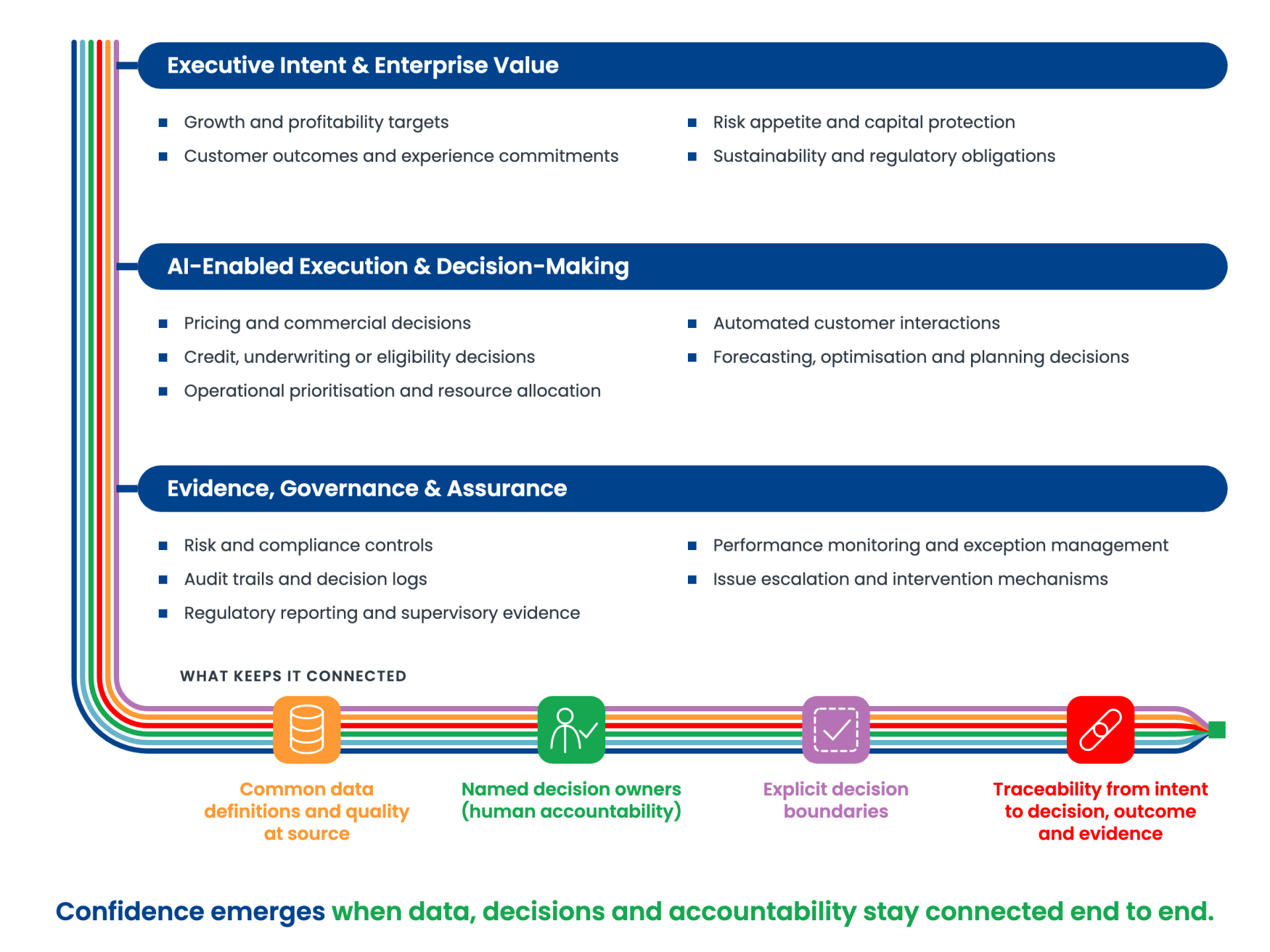
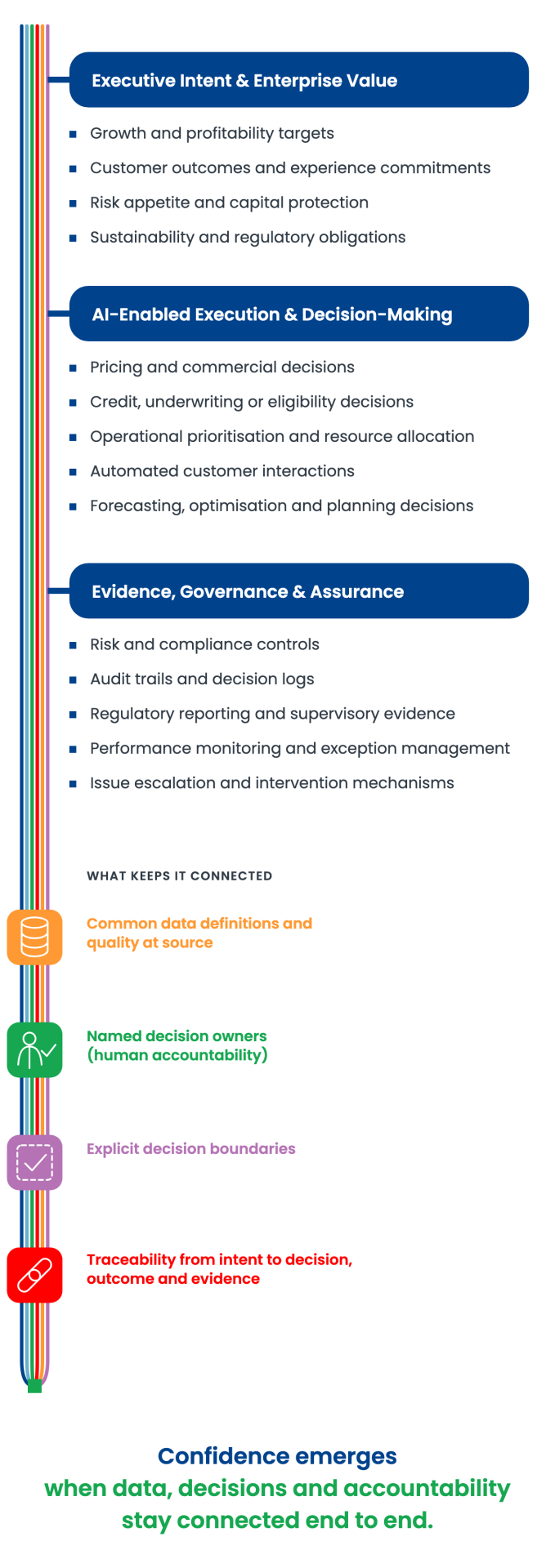
This model illustrates a structural principle: confidence is a property of enterprise design.
When executive intent, operational decision-making and assurance are connected as a single system:
• value remains visible as speed increases
• accountability remains clear as decisions decentralise
• evidence is available at the point of scrutiny
When these elements operate separately, alignment weakens.
What makes the difference is how well the enterprise is designed.
Why This Matters
Enterprises that embed these properties in their operating model:
• move faster because decisions are trusted
• intervene earlier because evidence is timely
• sustain value because outcomes remain measurable
Where these properties are absent, transformation slows because of structural misalignment rather than a lack of ambition.
Executive Self-Assessment
Understanding Your Confidence Gap
This section invites Boards and senior executives to examine a single question:
Are value, accountability and control structurally embedded in how the enterprise operates, or implicitly assumed?
The questions that follow should be considered together. Difficulty answering several of them consistently may indicate where enterprise design and operating reality are misaligned.
Confidence in Value
How leaders test whether value is real, credible, and defensible
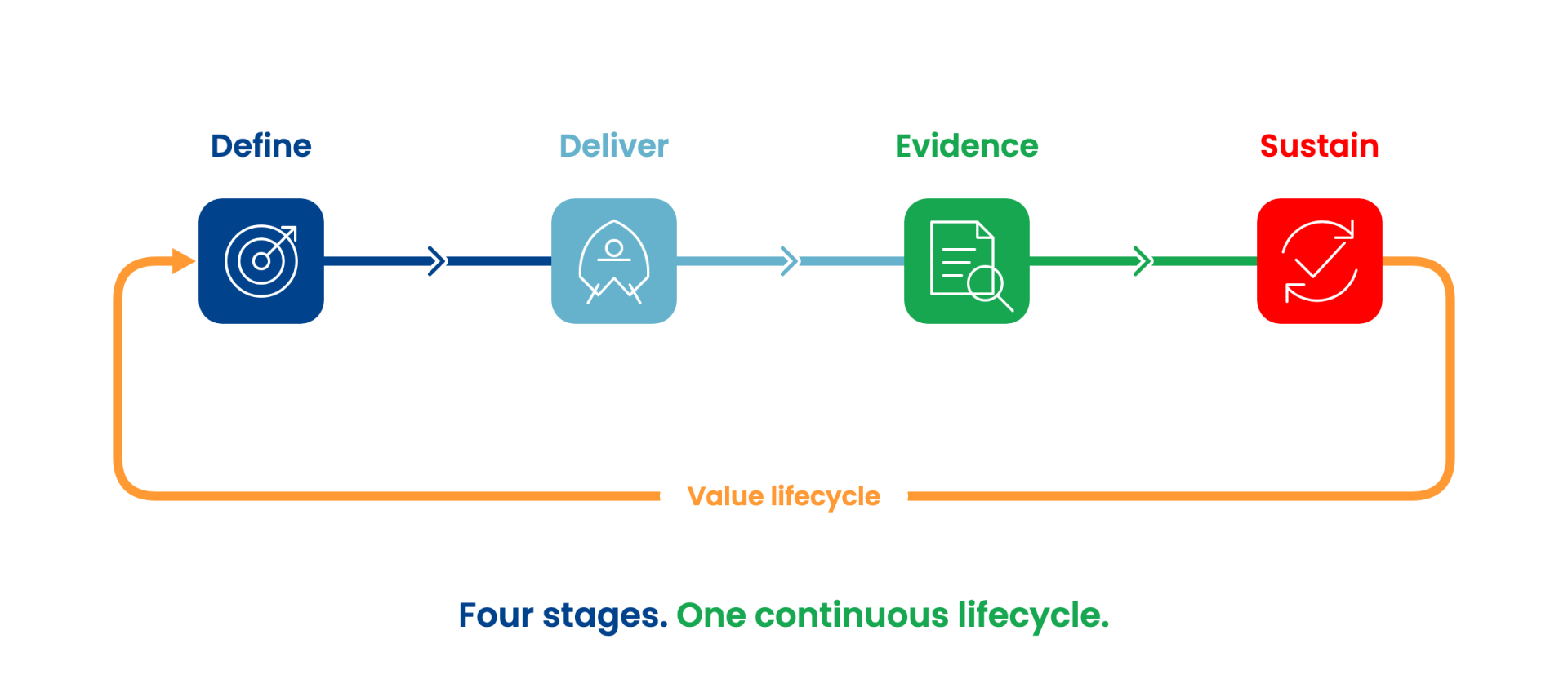
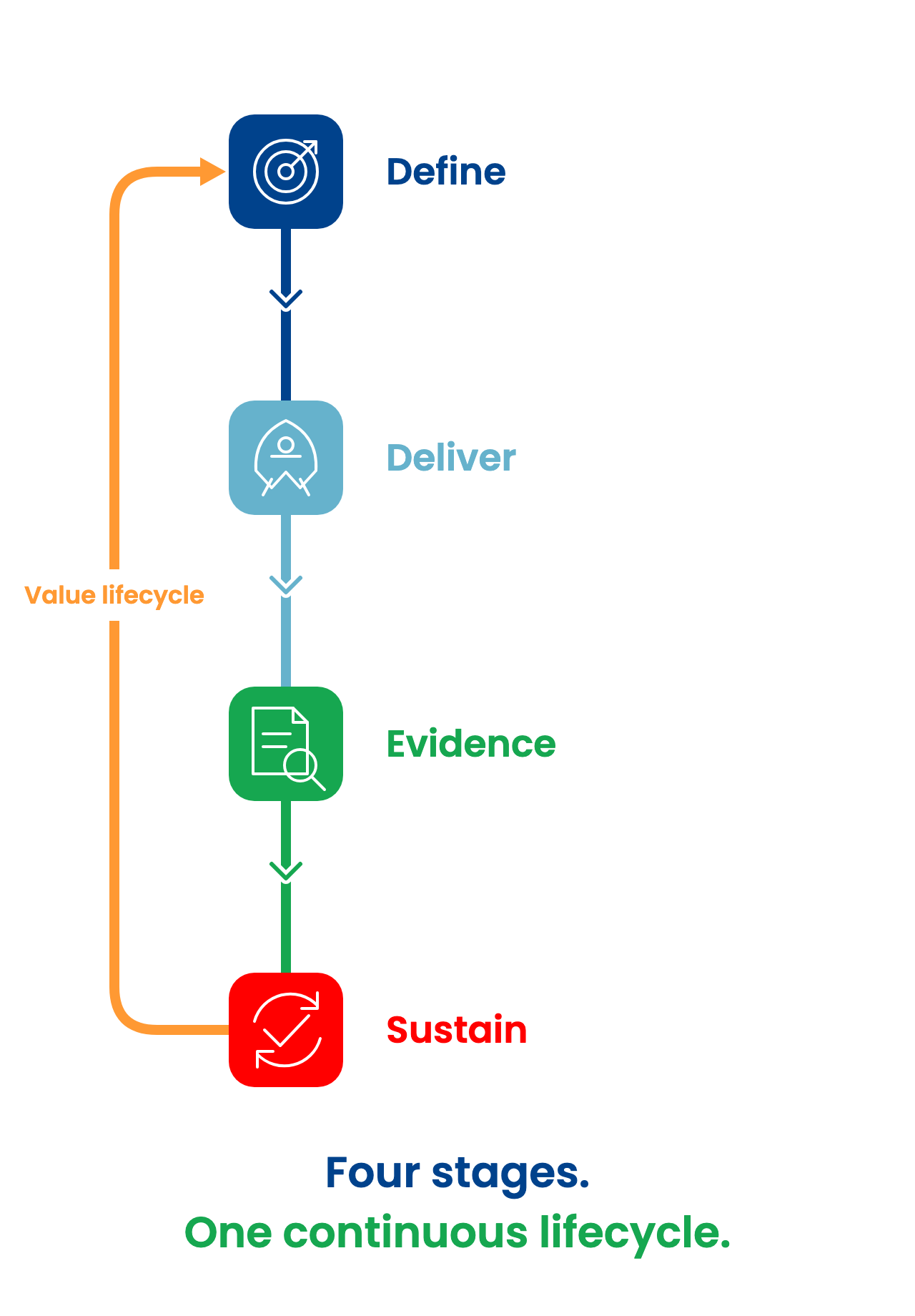
Confidence in transformation begins with credible value.
Most organisations can articulate expected value. Far fewer can evidence value as change unfolds.
Value is often inferred from:
• milestones achieved
• outputs delivered
• progress reported
Such indicators track delivery, which is different from verified value.
This section tests whether leaders can:
• distinguish value realised from value assumed
• identify where value is at risk
• intervene before credibility and momentum decline
Where value rests on narrative rather than evidence, confidence weakens.
Confidence in Value — Executive Structural Test
Realised vs Forecast Value
Can we distinguish realised value from forecast in real time?
Executive Ownership
Is value explicitly owned by named executives, and is that ownership accepted when outcomes fall short?
Value at Risk
Do we know where value is underperforming, and can we intervene before erosion becomes entrenched?
Measurement Discipline
Are baselines and measurement logic agreed before delivery begins, rather than debated once outcomes are questioned?
Enterprise Value Translation
Can we explain today how transformation spend is translating into measurable enterprise value, and not just programme progress?
Accountability in an AI-Enabled
Enterprise
Designing Clear Human Accountability at Decision Speed
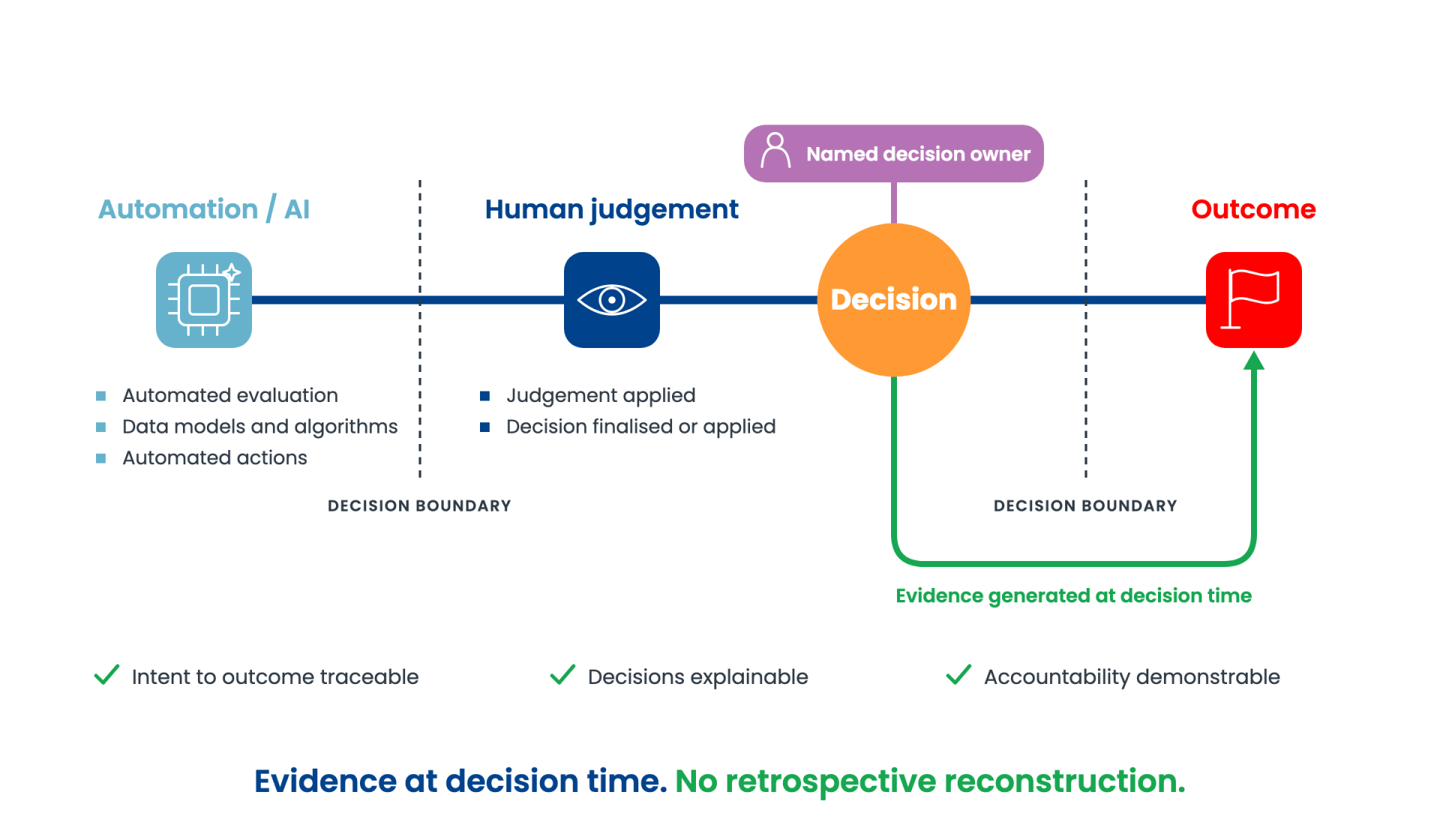
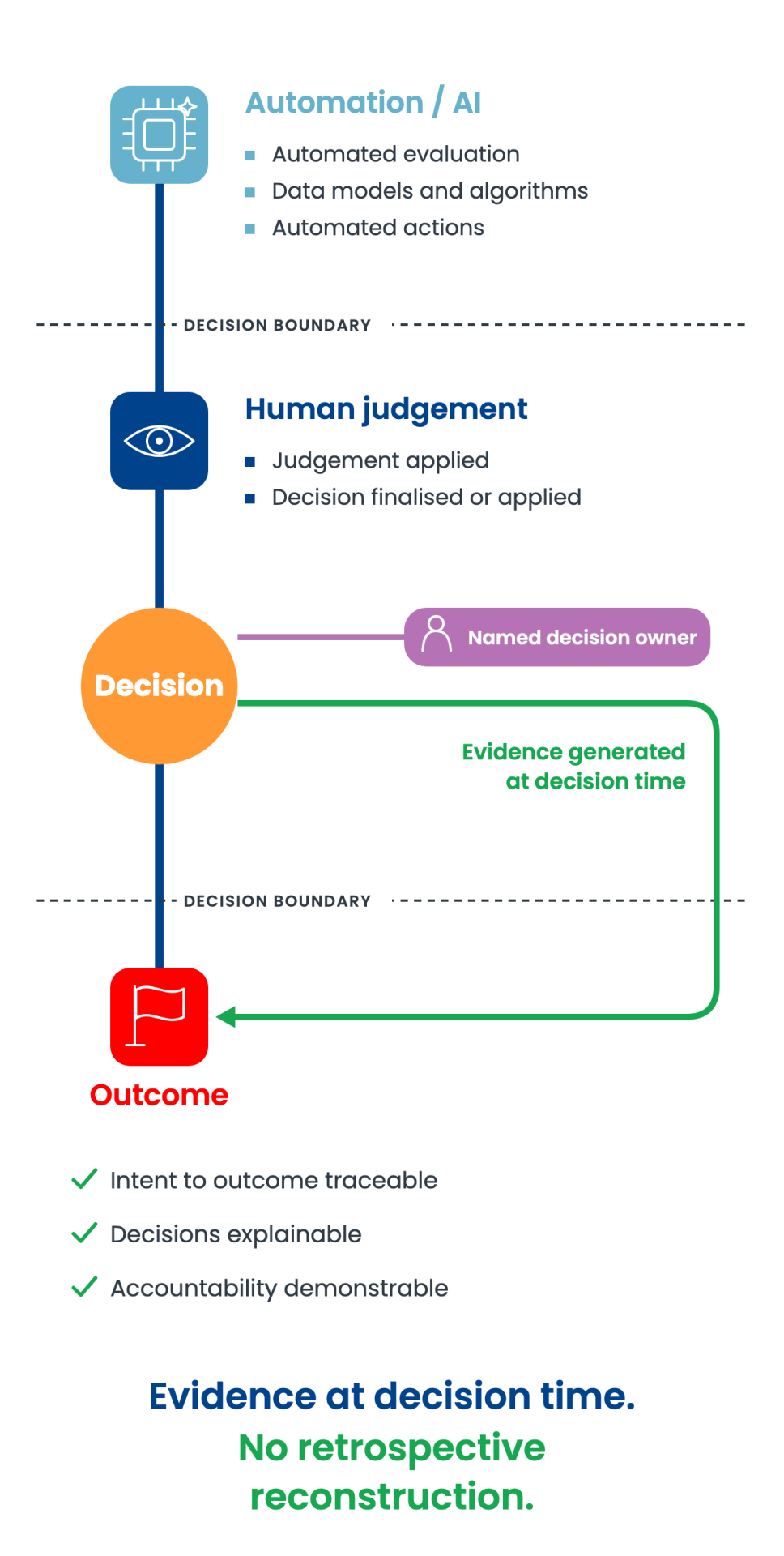
Confidence in AI-enabled decision-making depends on explicit human accountability.
As automation scales, decision ownership shifts. Decisions may be:
• automated through models and rules
• AI-assisted with human override
• distributed across human–machine workflows
Without deliberate design, accountability becomes unclear at decision level, particularly when outcomes affect customers, risk or financial exposure.
Leaders must be able to:
• define clear decision boundaries
• assign named human owners to AI-assisted outcomes
• evidence how human judgement or override is applied in practice
Where accountability exists only in policy, and not in operational evidence, it becomes difficult to defend under scrutiny.
Accountability in AI-Enabled Decision-Making — Executive Structural Test
Decision Boundaries
As automation increases, are human–AI decision boundaries explicit and operational, or merely implied?
Named Human Ownership
When AI-assisted decisions affect customers, risk, or financial outcomes, is there a clearly named human owner, visible in practice and not just in policy?
Human Override
Do leaders feel confident challenging or overriding AI-driven outcomes when required, or has automation become authoritative by default?
Embedded Judgement
Could we demonstrate, with evidence, how human judgement is embedded in AI-enabled workflows?
Governance and Assurance at Speed
Enabling Speed Without Losing Control
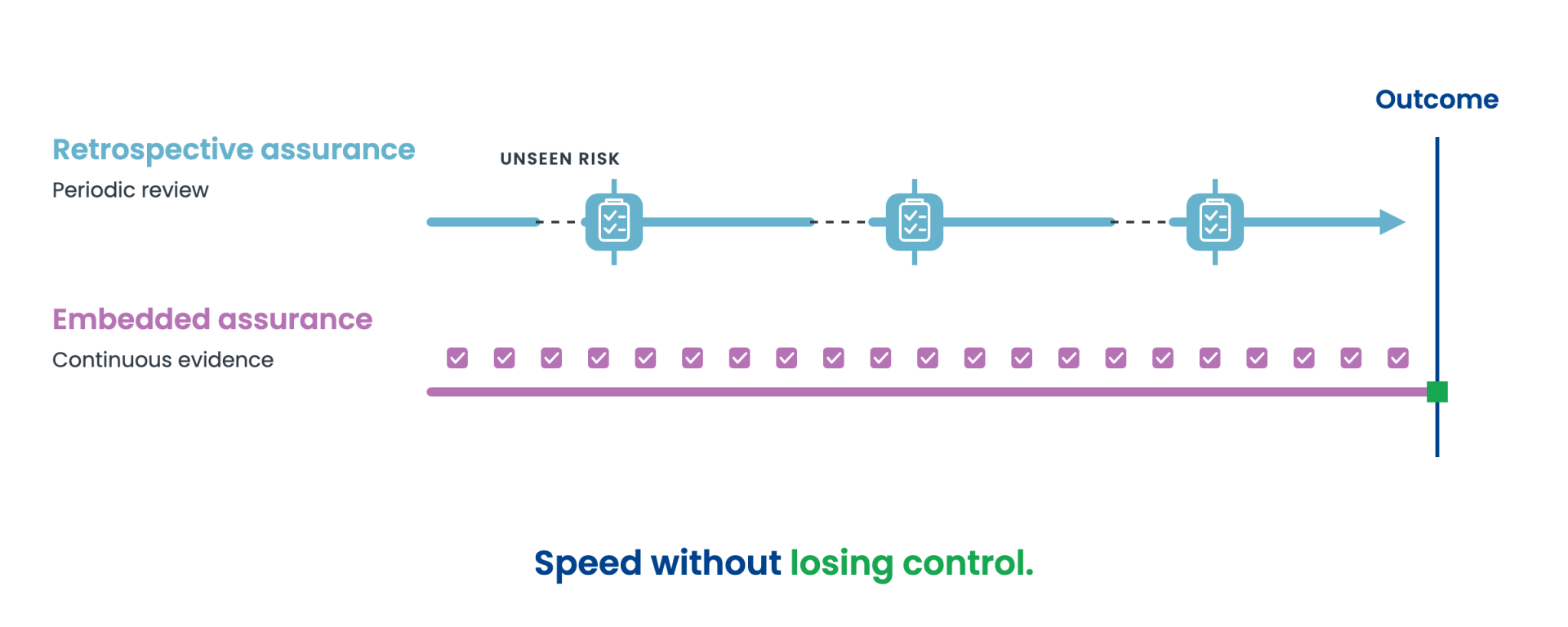
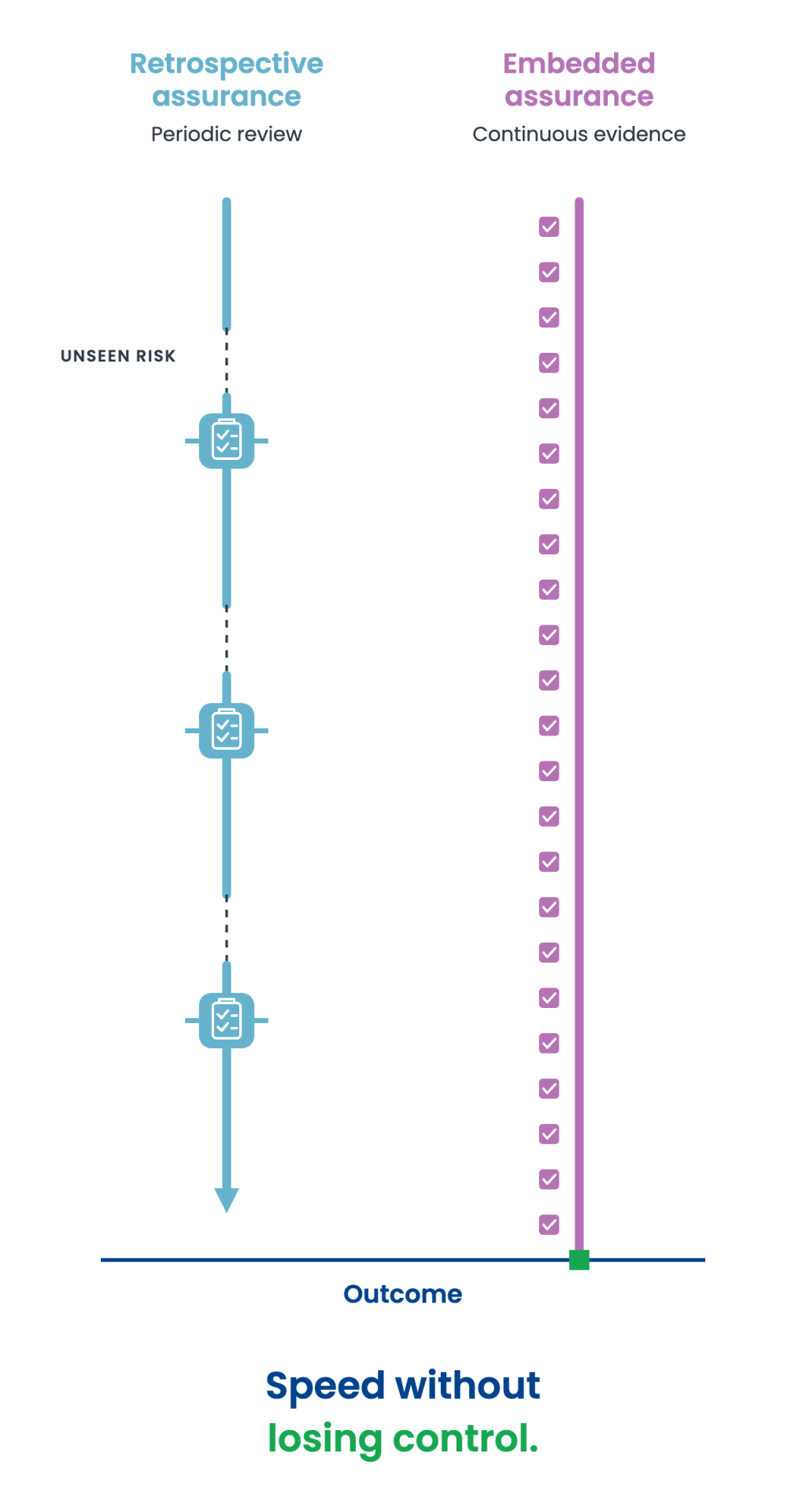
As AI-driven decision speed increases, confidence depends on how assurance operates more than on how much of it exists.
In many organisations, assurance remains periodic and retrospective.
In AI-enabled environments, where decisions are continuous and risk profiles evolve in real time, this approach struggles to keep pace.
Confident enterprises embed assurance in day-to-day workflows, supported by continuous, decision-level evidence.
The questions in this section test whether governance and assurance are designed to operate at decision speed or rely on after-the-fact review.
Effective assurance scales with speed. Retrospective assurance does not.
Governance & Assurance — Executive Structural Test
Decision-Speed Governance
Do governance and assurance mechanisms operate at the pace decisions are made?
Or do they rely on periodic review and retrospective reporting?
Proportionate Controls
Are controls calibrated to risk level?
Do they enable speed where risk is understood and apply discipline where risk is elevated?
Embedded Assurance
Is assurance embedded in daily operations?
Or is it layered on top as a separate review function?
Continuous Evidence
Can control be evidenced continuously as initiatives move from strategy to delivery to business-as-usual?
Proportionate, embedded assurance keeps pace with decisions.
Evidence, Traceability, and Defensibility
Proving Decisions, Outcomes, and Control Under Scrutiny
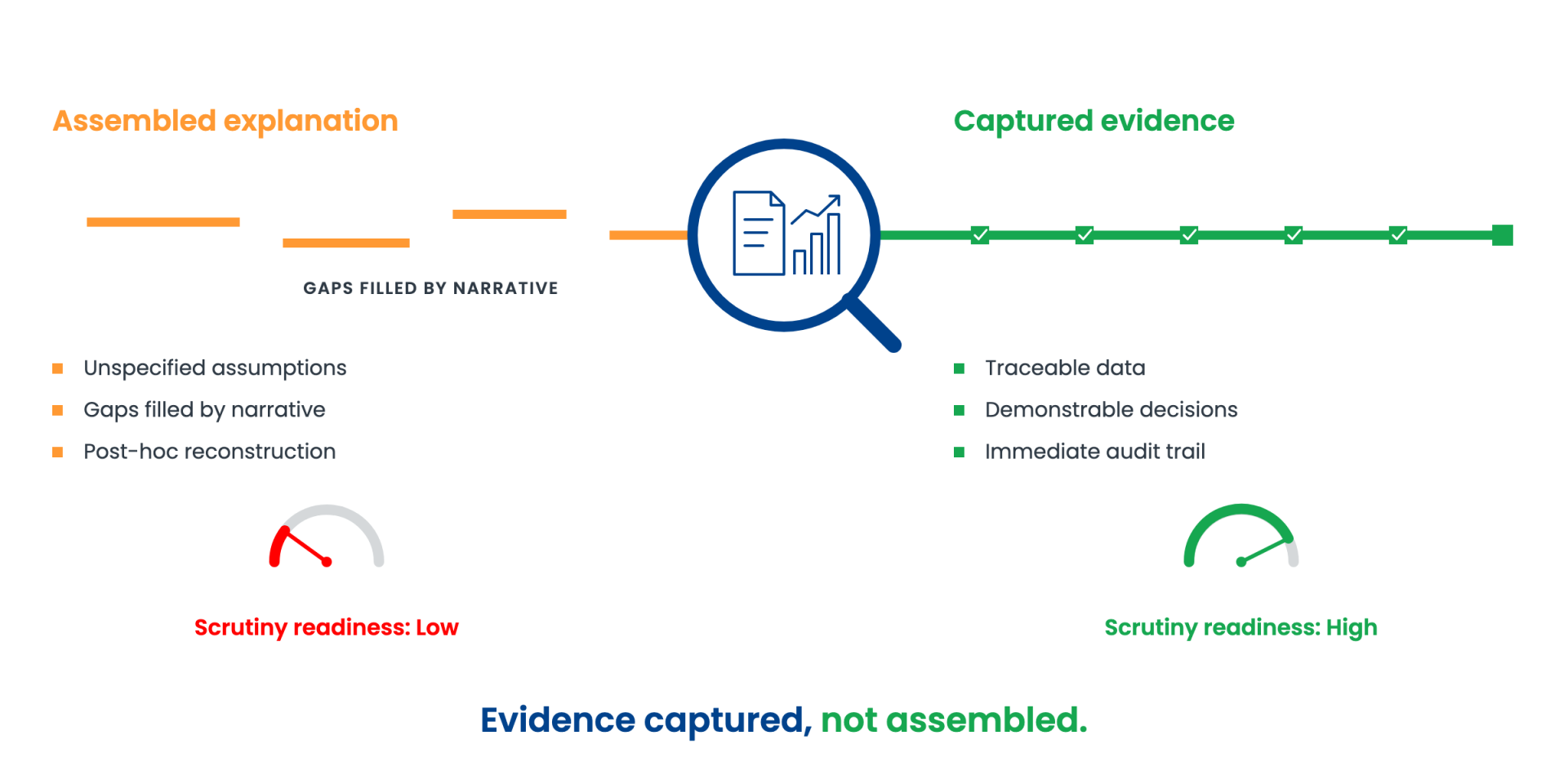
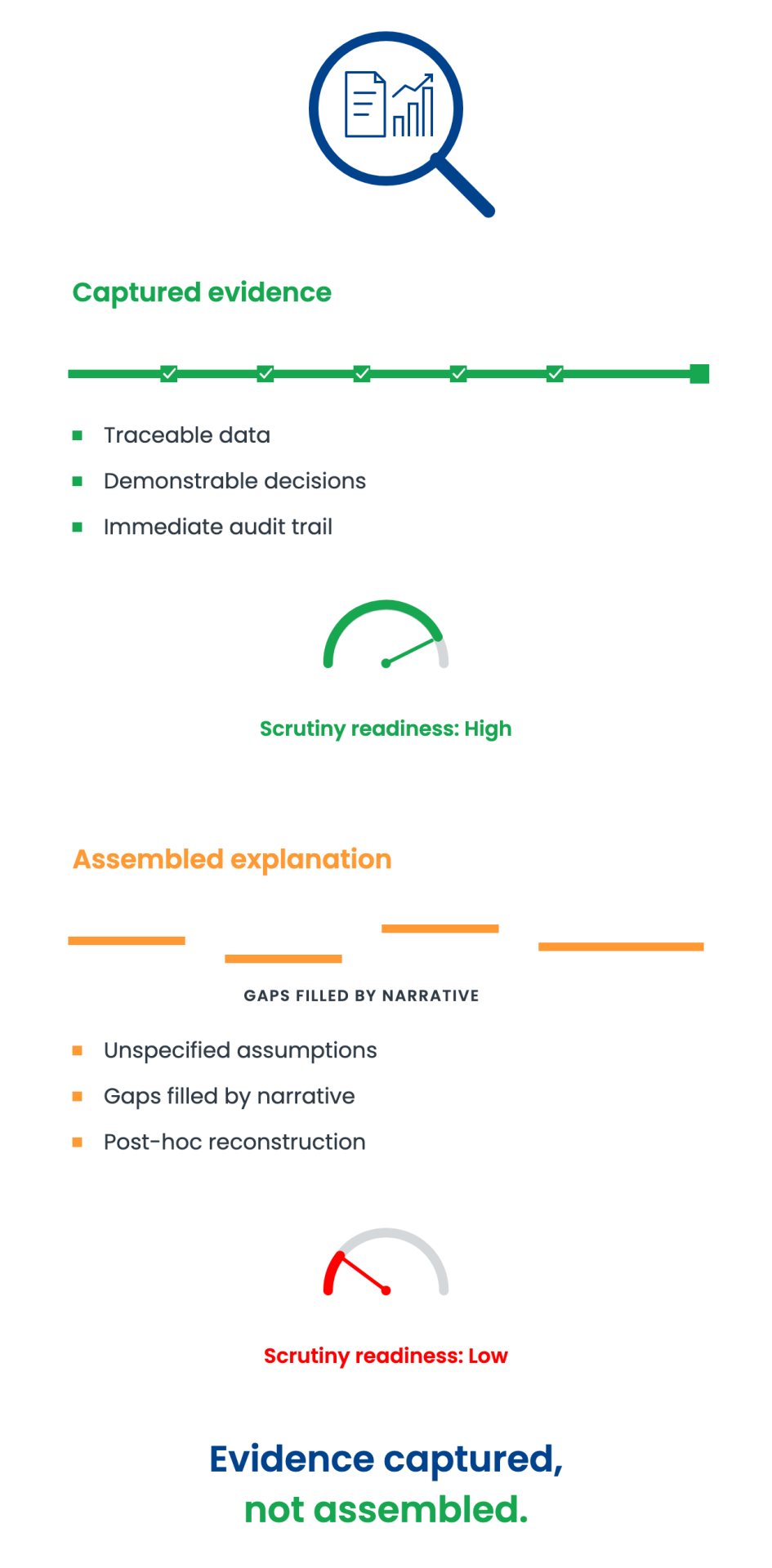
In AI-enabled environments, confidence depends on when evidence is generated more than on how well decisions are explained later.
Many organisations still rely on post-decision narrative, meaning explanations assembled after the fact.
These may support internal discussion but often weaken under regulatory, audit or external scrutiny.
Confident enterprises design workflows so that traceability, decision logic and control evidence are captured at decision time.
Confidence is demonstrated through evidence, not interpretation.
Evidence, Traceability & Defensibility — Executive Structural Test
Decision Reconstruction
Can we reconstruct how a significant decision was made, including data inputs, model logic and human judgement?
Real-Time Evidence
Is evidence generated at decision time, or assembled later through narrative reconstruction?
Scrutiny Readiness
Would we be comfortable demonstrating our decision-making and control environment to regulators, auditors or Board committees tomorrow?
Evidence vs Interpretation
Do we rely primarily on traceable, auditable fact, or on explanation and interpretation after scrutiny begins?
Traceable facts captured at decision time outweigh any later interpretation.
Enterprise Coherence
Running Transformation as a Coherent Enterprise System
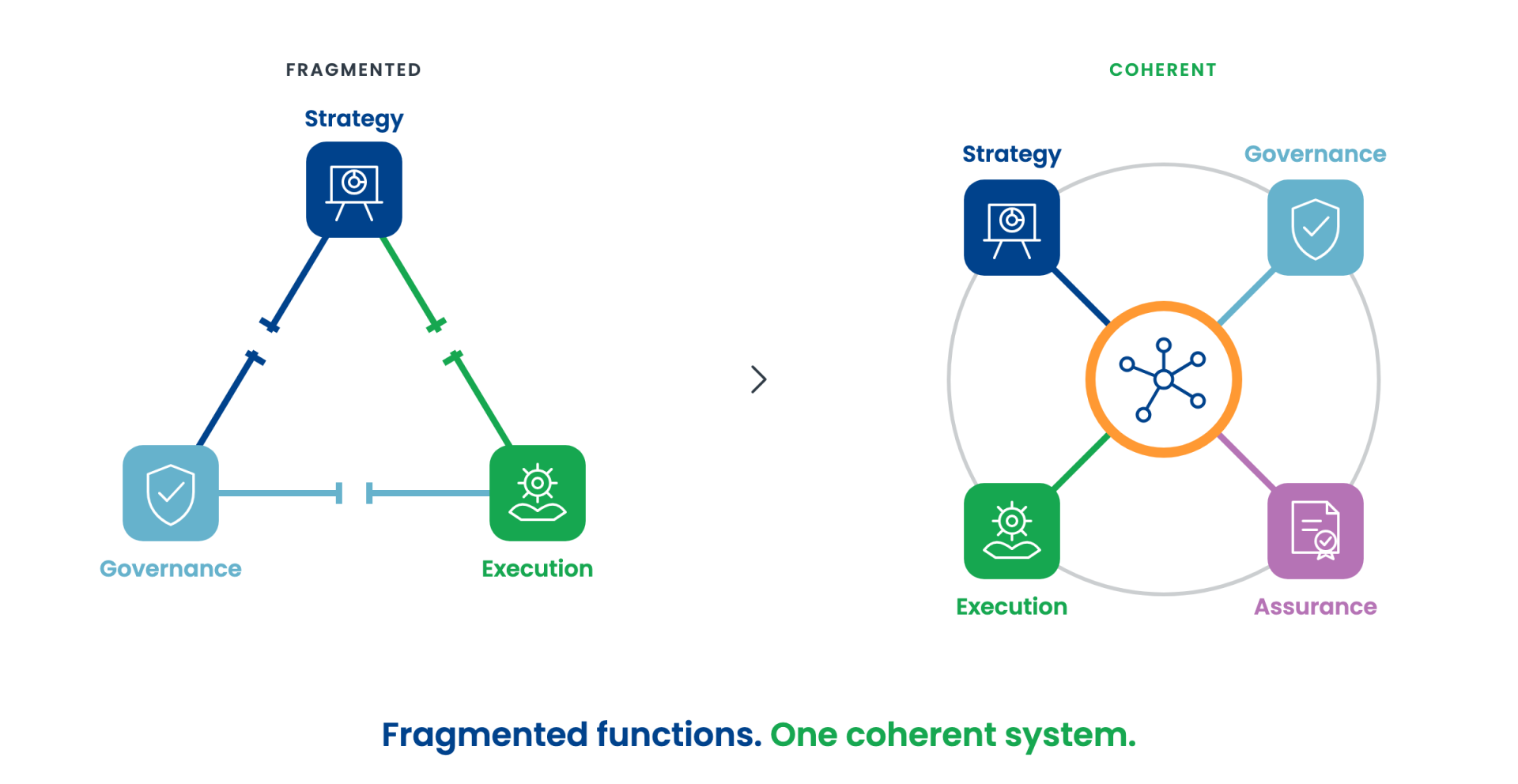
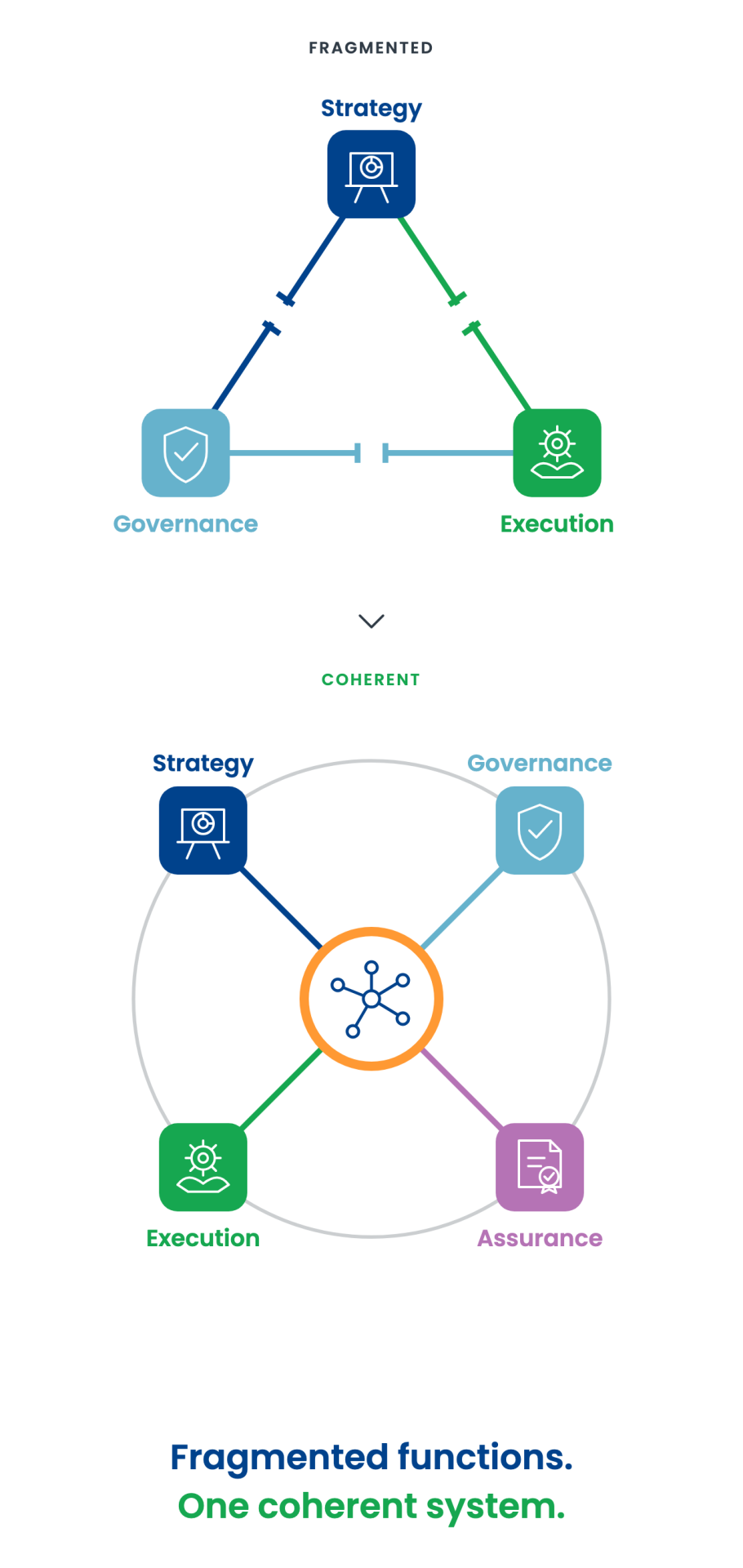
Running transformation as one system means strategy, delivery, governance and assurance are linked, so a change in one area is reflected in value, risk and accountability elsewhere.
Where initiatives are coordinated rather than connected, the gaps between them are filled with assumption or narrative.
Confident enterprises connect these elements and generate evidence at decision time, creating defensibility without retrospective reconstruction.
Confidence is what stands up to scrutiny.
Enterprise Coherence — Executive Structural Test
System Alignment
Do strategy, execution, governance, and assurance operate as one coherent system, or as loosely connected activities?
Executable Operating Models
Are operating models executable in practice, or primarily conceptual?
Where do hand-offs, silos, or workarounds break value flow?
Adaptive Coherence
When priorities shift, can the enterprise adapt coherently, or do initiatives move independently in different directions?
Interpreting What You See
There is no single score that matters. What matters is where confidence weakens.
• If answers rely on intent, policy, or narrative, confidence is likely assumed.
• If answers rely on evidence, ownership, and traceability, confidence is being designed.
The critical insight lies less in how many questions raise concern than in which structural weaknesses they reveal.
Closing Reflection
In AI-enabled enterprises, confidence is an enterprise design capability that has to be built deliberately.
Organisations that design for confidence:
• sustain measurable value as automation scales
• maintain clear human accountability at decision speed
• generate evidence that stands up under scrutiny
Where this design is absent, transformation slows because credibility weakens.
Executive Playbooks

Executive Playbooks
Board-level playbooks designed to help senior leaders navigate enterprise-wide transformation in AI-enabled environments — examining confidence in value, accountability, governance, and control as organisational speed and complexity increase.
Insights from Data Inc
Ideas. Evidence. Measurable Outcomes.
Explore our latest articles and analyses, from AI and data governance to sustainable transformation.
Stay informed, inspired and ahead with insights that can transform your approach to data leadership.

Envalue™ Now Carries IFRS Standards Inside
A return is only as sound as the investment it is measured against.

Data Inc Joins the Claude Partner Network
London, July 2026 — Data Inc is pleased to announce that it has been selected as a member of the Claude Partner Network, Anthropic’s authorised partner programme for organisations that build Claude into their enterprise products and services. Data Inc joins the...

Transformation Has Always Been the Work
Transformation Has Always Been the Work The pace of change in enterprise technology continues to accelerate. AI is now a central part of that conversation, shaping how organisations think about growth, efficiency and scale. What stays consistent, however, is where...

Data Inc appointed to provide ISAE 3000 assurance for major UK Bank
London, January 2026 — Data Inc has been appointed by a global bank to give independent assurance on the replacement of its client account and asset platform. The work centres on data integrity, proof of customer value and control traceability at every step. The...

Scaling SME Performance through Connected Value Systems
Data democratization is revolutionising how organisations handle information by making data accessible to all employees, not just data analysts. This blog explores how companies like the Royal Bank of Scotland are leveraging this inclusive approach to enhance decision-making and customer experiences. Discover the key strategies for implementing effective data democratization, from adopting advanced analytics tools to ensuring robust data governance, and learn why this shift is essential for any competitive business in the digital age.

The Data Operating Model of Transformation
Data democratization is revolutionising how organisations handle information by making data accessible to all employees, not just data analysts. This blog explores how companies like the Royal Bank of Scotland are leveraging this inclusive approach to enhance decision-making and customer experiences. Discover the key strategies for implementing effective data democratization, from adopting advanced analytics tools to ensuring robust data governance, and learn why this shift is essential for any competitive business in the digital age.