
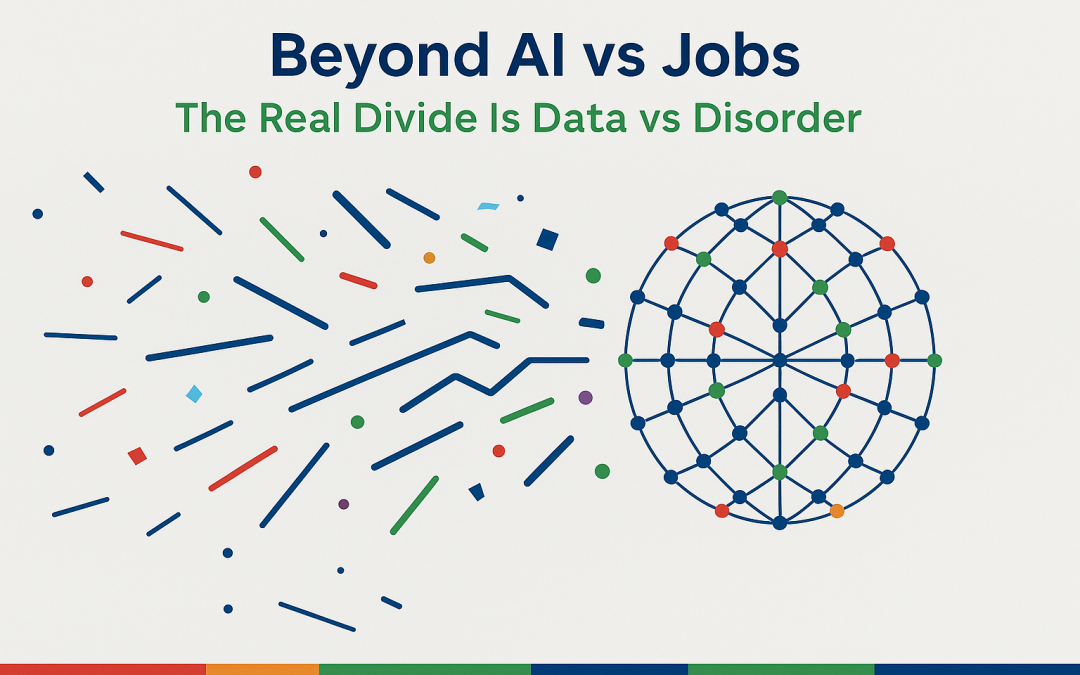
Beyond AI vs Jobs: Why Data Capability Determines the Future of Work
The global debate on artificial intelligence often centres on one question: Will AI take our jobs?
It is an understandable concern. Automation is advancing fast, reshaping whole industries and redefining routine work. Yet beneath the headlines sits a more fundamental reality:
AI itself is not the decisive force; data capability is.
The impact of AI, good or bad, depends on the quality, accessibility and governance of the data beneath it. When data is fragmented or poorly governed, automation introduces volatility. When data is connected, trusted and well understood, AI becomes a strong driver of productivity, creativity and sustainable growth.
How well institutions organise and govern their data foundations will shape the future of work far more than algorithms replacing people.
AI’s opportunity emerges when data is trusted, governed and orchestrated at scale.
Reframing the Debate: From AI vs Jobs to Data Maturity
The popular “AI versus jobs” story frames transformation as a question of labour displacement. In practice, the dividing line runs through data maturity rather than through types of worker.
Experience across industry and government points to a consistent pattern. Organisations with strong data governance and interoperability see augmentation, with AI helping people work faster, better and with more confidence. Those without it see disruption, as automation tries to make up for fragmented, manual processes.
Where data is clean, contextual and shared, AI augments what people can do.
Where data stays in silos or is inconsistent, AI struggles to scale reliably.
The leaders in the AI economy will be defined less by the sophistication of their models than by the strength of their trusted data ecosystems.
Why Data Capability Shapes Workforce Outcomes
Many organisations treat AI mainly as a technology initiative, when in practice it is a wider shift in governance and operating model. Where data foundations are still evolving, a few predictable problems appear:
- Model reliability: inconsistent datasets lower confidence in outputs and call for manual intervention.
- Regulatory assurance: unclear lineage complicates auditability and compliance.
- Adoption momentum: when figures change from one report to the next, staff stop trusting them and use slows.
In each case, the constraint lies in the maturity of the data environment behind AI.
When data is governed across its whole lifecycle, trust follows, and trust is what lets AI be used responsibly and productively.
Trusted Data as a Multiplier of Human Value
When data is unified, governed and auditable, AI becomes a powerful multiplier of human intelligence.
Rather than replacing people, it frees their time for judgement, creativity and higher-value decisions.
A risk analyst working from data with verified lineage spends less time reconciling inputs and more time on the exposure itself.
A sustainability leader using integrated ESG datasets can report with confidence rather than caveats.
A customer-experience team with trusted behavioural data can personalise engagement ethically and at scale.
Organisations can work towards these outcomes by orchestrating data across people, process and platform through the
Integrated Transformation Framework™.
AI amplifies what people can do when the data beneath it is consistent, contextual and complete.
From AI Ambition to Data Confidence
Many enterprises are investing heavily in AI, yet many still do not describe themselves as AI-mature. The reason is simple:
models are often pursued before data foundations are in place.
High-performing organisations reverse this order. They begin with common data models, shared taxonomies, defined stewardship and measurable governance, and then embed AI into workflows and decisions with confidence.
This move from AI ambition to data confidence tends to involve:
- Assessing data readiness: knowing the lineage, ownership, quality and risk.
- Defining enterprise ontology: agreeing shared definitions of customers, products, risks and controls.
- Embedding governance: balancing agility with assurance.
- Operationalising AI: building use cases with measurable ROI.
Across pricing, risk, ESG and operational platforms, this sequence moves AI from experimentation to scale.
Why Institutional Readiness Matters Most
One pattern stands out: institutional readiness, more than workforce readiness, is the limiting factor.
Employees are already adopting AI tools. What often lags is the operating model that integrates governance, insight and execution.
Closing that gap needs an enterprise approach that connects data, assurance and value, built on
data you can trust and outcomes you can evidence.
The Real Frontier: Data Capability at Scale
The next phase of economic transformation will be shaped by information, and information delivers value when it is governed, contextualised and shared.
The organisations that manage the data behind AI well will set its course.
When data capability is mature, AI can raise productivity and support sustainable growth.
This is where Data Inc focuses: helping enterprises turn trusted data into enterprise-wide AI, and AI into measurable value.
AI’s opportunity begins with data that is trusted, governed and orchestrated.
Ready to Build AI on Trusted Data?
Partner with Data Inc to orchestrate AI with confidence, in a way that is governed, measurable and human-centred.
AI delivers lasting value when data comes first.