
Transformation Engineered Through Data
Architected for Control. Delivered with Evidence.
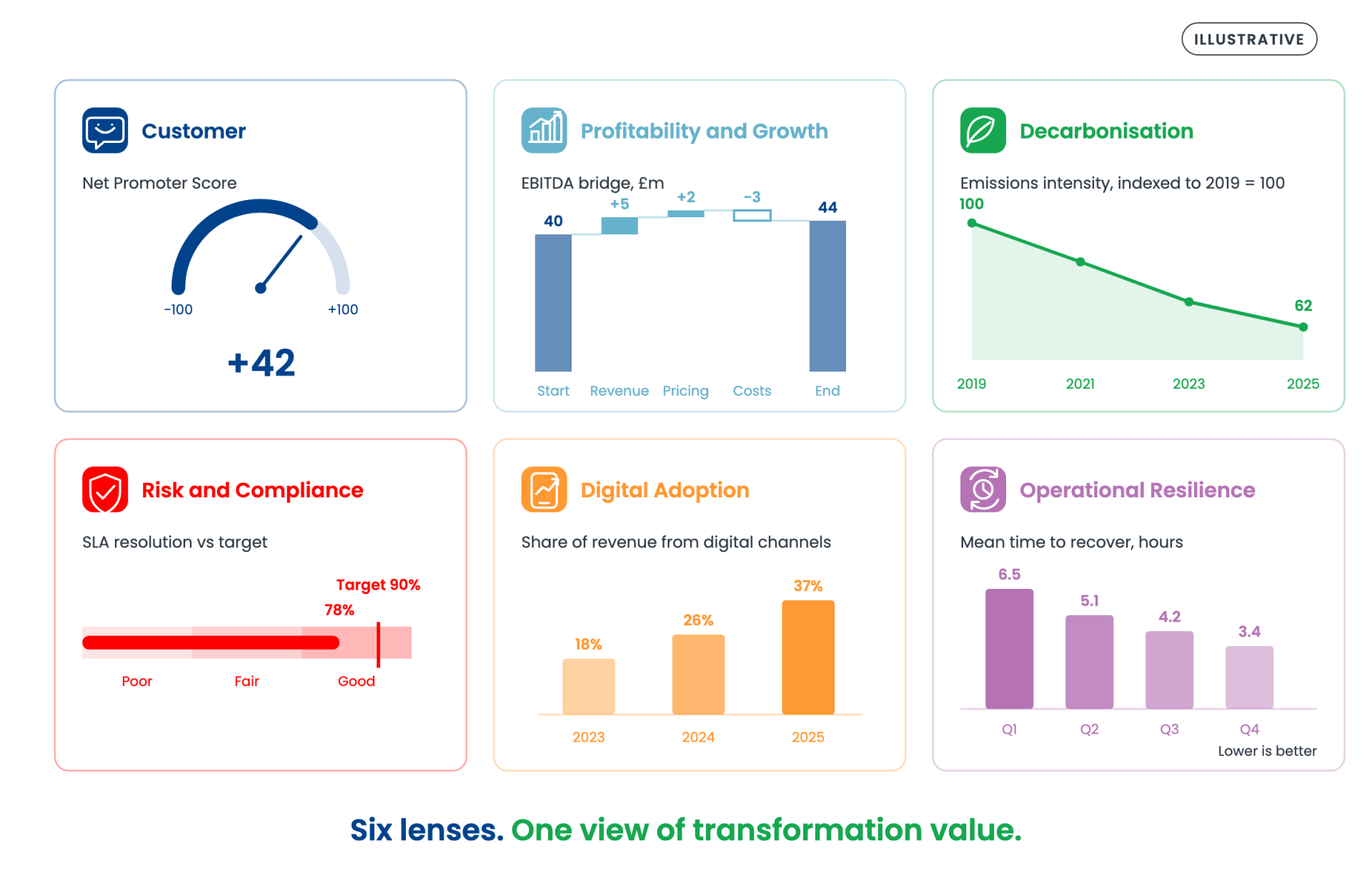
The Transformation Scorecard
From Strategic Intent to Measurable Impact
Unless transformation is measured with discipline, it weakens control, blurs accountability and hides value.
Our Transformation Assurance capability governs how change is delivered. Delivery stays controlled and adoption is evidenced. Outcomes can be shown as transformation moves into business as usual.
The Enterprise Value Framework ties each transformation goal to clear business outcomes. These are financial performance, risk posture, operational resilience, customer experience and sustainability.
The Transformation Scorecard turns strategic aims into decision-grade KPIs. They draw on business context, regulatory duties and live telemetry.
It shows executives progress, variance and value realisation. They can then set priorities, step in with confidence and report in a defensible way.
Each strategic pillar (Vision, Strategy, Planning, Operations, Transformation, Sustainability) rests on a connected data architecture. This keeps aims, delivery and results in line.
The Integrated Transformation Framework™
An Operating Architecture for Controlled, Measurable Change
Institutionalising Execution Through Data, Governance and Design
The Integrated Transformation Framework™ is Data Inc’s operating architecture for how enterprise change is governed and run.
It links data architecture, operating model design, delivery governance and value management in one life cycle. Transformation then stays controlled, measurable and true to its strategic aim.
The ITF is built on an enterprise ontology. It sets out how data, skills, controls and outcomes relate. Change then stays coherent across portfolios, functions and regulatory boundaries.
It is built on a library of structured artefacts. These include value scorecards, risk controls, delivery standards and adoption frameworks. With them, the ITF embeds execution discipline from strategy through to business as usual.
Structured lifecycle governance links ambition, funding, delivery and measurable outcomes.
End-to-end capability alignment brings data, technology, people and control teams into one model.
Embedded measurement and control builds KPIs, risk signals and benefit tracking into delivery from the start.
Traceable scale comes from a modular architecture. It can be reused across portfolios, jurisdictions and sectors.
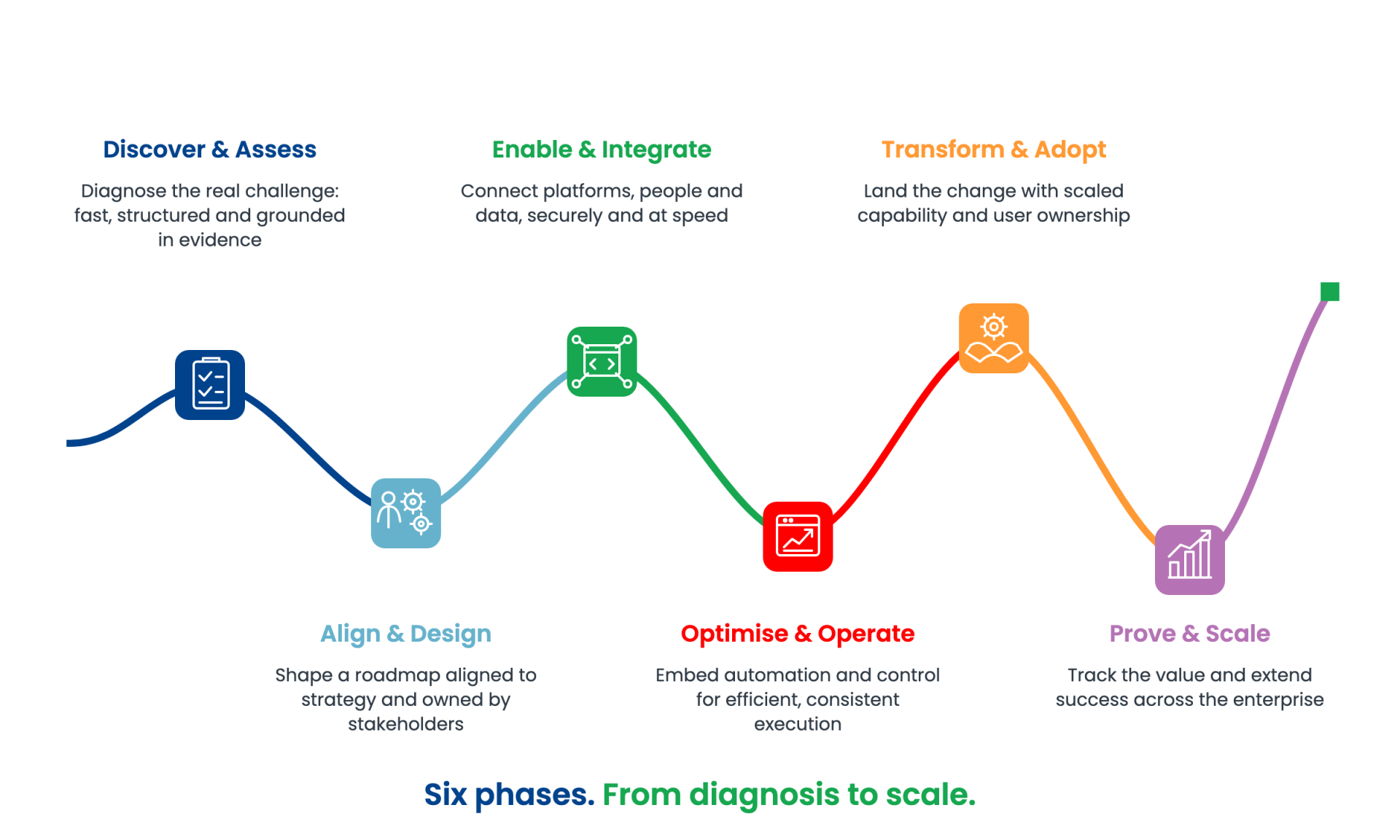
The Six-Phase Transformation Lifecycle
Structured Execution From Intent to Institutionalised Scale
Discover & Assess – Set the strategic aim, then assess current performance, risk posture and data maturity. This fixes the transformation scope and the goals to measure.
Align & Architect – Design target operating models, data architecture, governance and accountability frameworks, all tied to enterprise value.
Enable & Integrate – Put in place platforms, controls, workflows and interoperability standards in a governed delivery model.
Operate & Optimise – Build performance tracking, risk monitoring and continuous improvement into how the business runs.
Adopt & Institutionalise – Align skills, incentives and behaviour so adoption lasts and executive accountability is clear.
Assure & Scale – Validate outcomes with evidence and formally hand controls over to business as usual. Then repeat success across portfolios.
From this phase on, value assurance runs all the time. It links what delivery achieves to the financial statements, during execution and after. The Value Operating Model™ is the method Data Inc uses to put this to work. It makes value visible, attributable and reconcilable — from the first governance discussion to programme close. It then carries on into steady-state operations. Explore the Value Operating Model™ →
Workforce Enablement as Operating Discipline
Sustainable transformation needs skills to change as the architecture does. The Integrated Transformation Framework™ builds in a structured Workforce Enablement model. It aligns talent, incentives and behavioural accountability with each phase of delivery.
- Capability Realignment: Reskilling that is planned around new processes, data models and automation architecture.
- Accountability & Adoption Governance: Clear owners, clear goals and behaviour metrics built into delivery oversight.
- Human–Automation Integration: Workflow design in which technology supports decision-making, while control and traceability are kept.
The model follows national skills frameworks such as the Skills England AI Skills Framework (2025). Staff skills then grow in step with data architecture and governance as they mature.
Integrated Enablers, Architected as One System
Coordinated Execution Across Data, Governance and Delivery
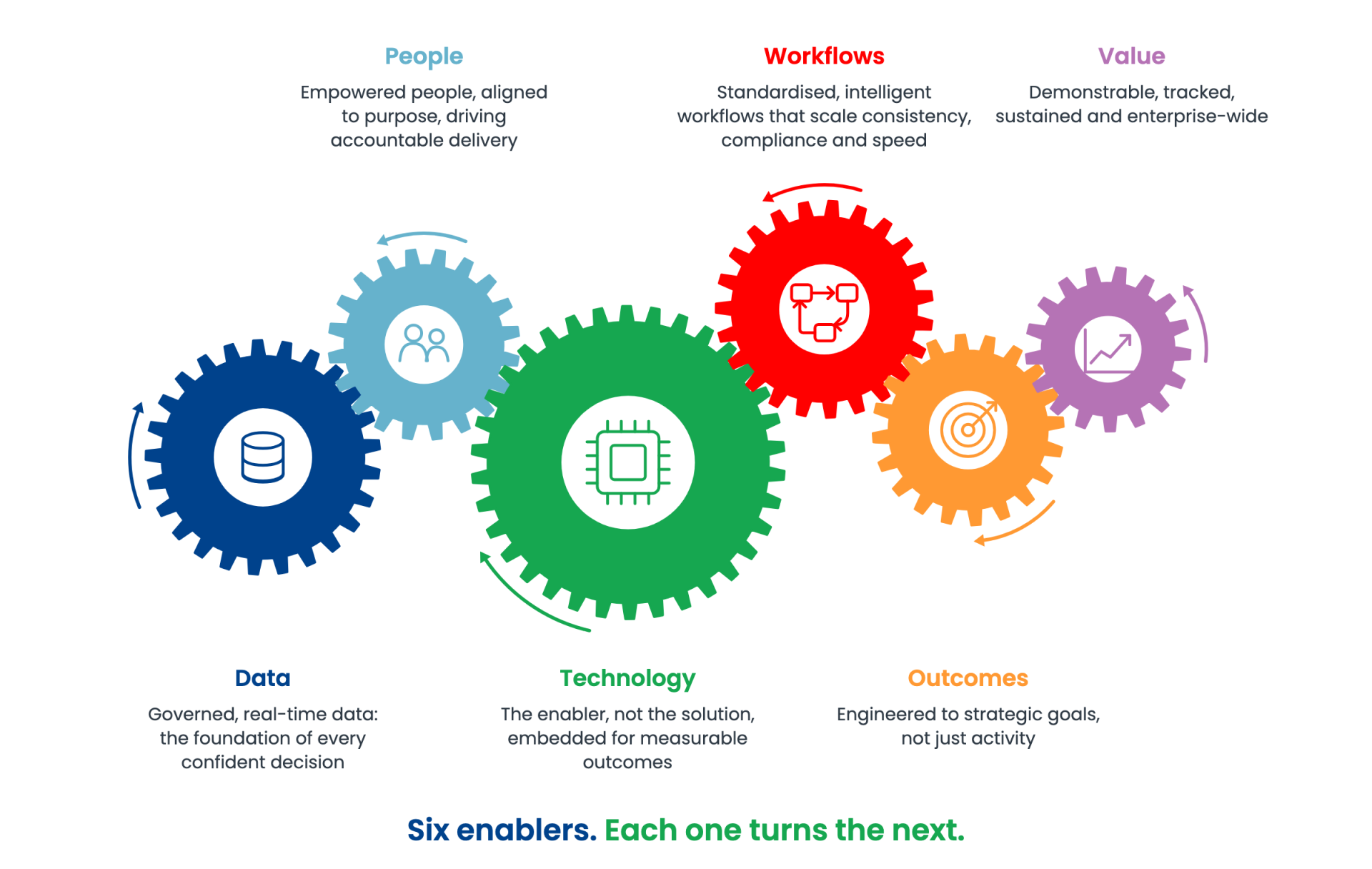
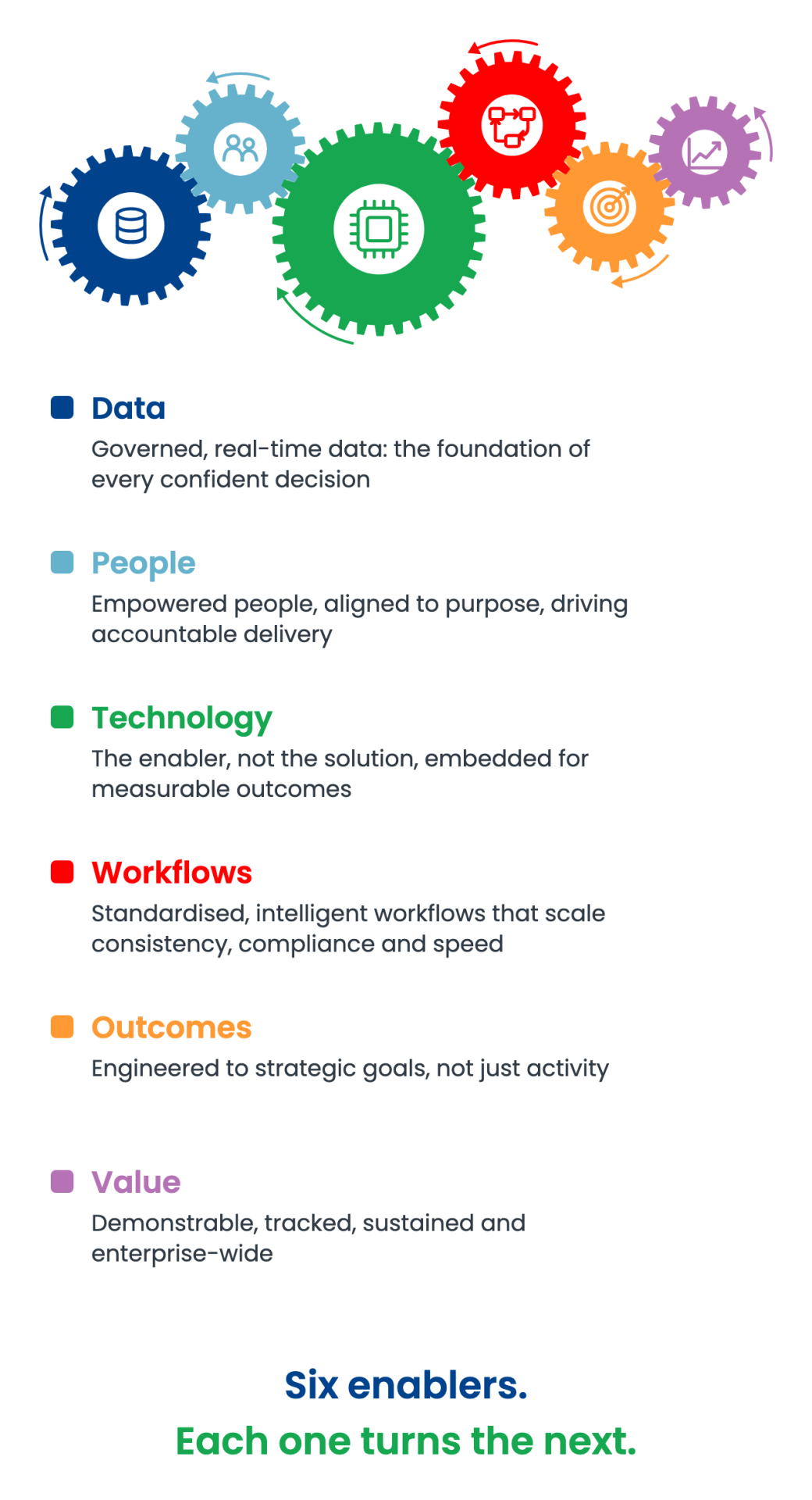
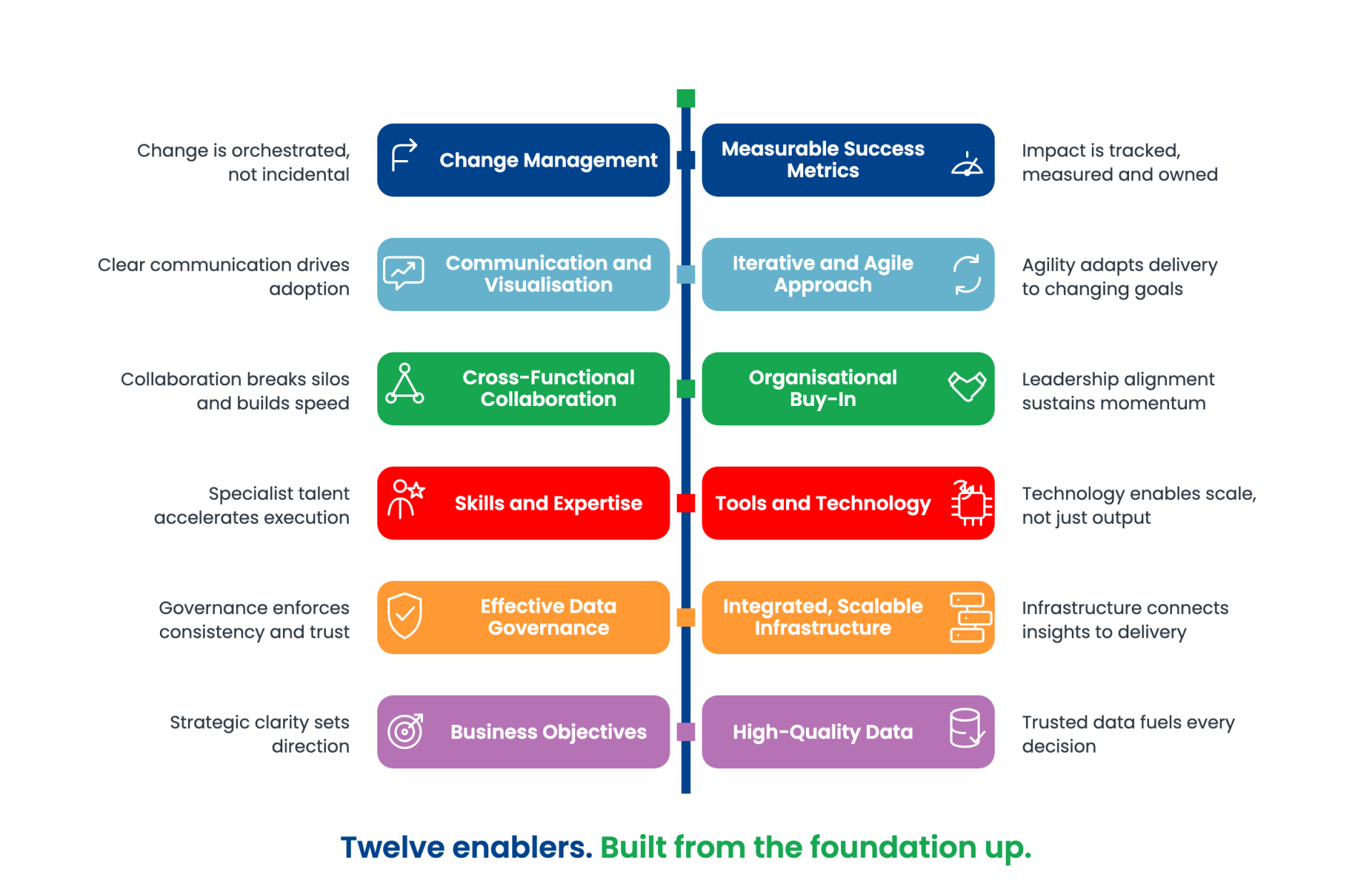
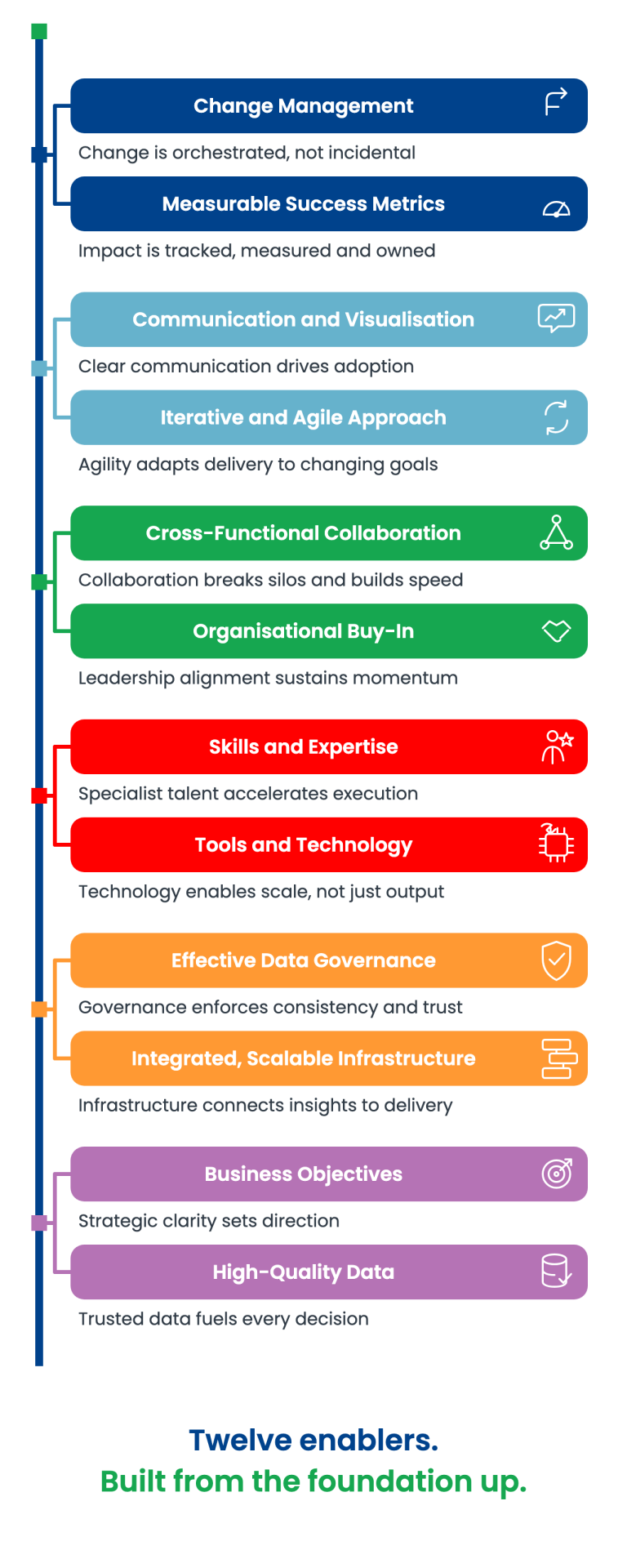
Enterprise transformation works as one system of linked initiatives. All of them are tied to shared value goals.
Data architecture, operating model design, governance controls and delivery must act as one. Each is tied to clear value goals and to built-in accountability.
The Integrated Transformation Framework™ makes sure these parts are architected together. It keeps control, traceability and measurable impact as complexity grows.
Each layer is defined, governed and tracked in one lifecycle, from data quality and business goals to skills and value assurance. Transformation then stays enterprise-grade: controlled, traceable and able to scale across portfolios, jurisdictions and regulatory regimes.
Why It’s Structurally Different
Engineered for Measurable Execution Across the Enterprise
AI-native architecture
builds intelligence, automation and model governance into how the business runs.
Data-first ontology
connects strategy, controls, processes and outcomes on a clear semantic base.
Execution instrumentation
runs delivery, risk and benefit realisation through built-in scorecards and telemetry.
Workforce integration
builds new skills, adoption and human–AI teamwork into the life cycle.
Regulatory alignment
builds in traceability, auditability and compliance controls from design to scale.
Why It Matters Now
Trust, Speed and Measurability Define Enterprise Performance
Automation is growing and agentic technologies are maturing. Enterprise value now depends on how well you orchestrate intelligence, governance and execution as one system. Each business must prove control, accountability and results as they happen.
The Integrated Transformation Framework™ gives you the discipline to move fast on transformation. It brings regulatory confidence and provable enterprise impact.
Benchmarking Against Global Standards
Architecturally Aligned to Recognised Frameworks
The Integrated Transformation Framework™ is aligned to recognised global standards for operating models, governance and transformation. This supports structural interoperability and regulatory coherence.
Enterprise operating model and strategy frameworks are in line with leading global transformation methods.
Data and control governance standards are in line with DAMA-DMBOK, DCAM, COBIT and related industry frameworks used in supervisory review.
Programme, change and scale delivery disciplines are built to work with PMI, MSP, SAFe and behavioural adoption models.
Sustainability and responsible AI principles are mapped to GRI, SASB, OECD AI guidance and World Economic Forum governance models.
This alignment means the ITF works as a common architecture. It fits supervisory expectations, industry governance standards and the regulatory rules of each sector.
Make Transformation Measurable
Architected Execution. Governed Delivery. Provable Enterprise Value.
The Integrated Transformation Framework™ gives you the discipline to turn strategic aims into controlled, measurable outcomes.
If your organisation puts AI-enabled growth, regulatory confidence and proven value first, we welcome a focused executive discussion. Together we can explore how the ITF applies to your enterprise.
Executive Playbooks

Executive Playbooks
Board-level playbooks designed to help senior leaders navigate enterprise-wide transformation in AI-enabled environments — examining confidence in value, accountability, governance, and control as organisational speed and complexity increase.
Insights from Data Inc
Ideas. Evidence. Measurable Outcomes.
Explore our latest articles and analyses — from cutting-edge AI and data governance to sustainable transformation.
Stay informed, inspired and ahead with insights that can transform your approach to data leadership.
Envalue™ Now Carries IFRS Standards Inside
A return is only as sound as the investment it is measured against.

Data Inc Joins the Claude Partner Network
London, July 2026 — Data Inc is pleased to announce that it has been selected as a member of the Claude Partner Network, Anthropic’s authorised partner programme for organisations that build Claude into their enterprise products and services. Data Inc joins the...

Transformation Has Always Been the Work
Transformation Has Always Been the Work The pace of change in enterprise technology continues to accelerate. AI is now a central part of that conversation, shaping how organisations think about growth, efficiency and scale. What stays consistent, however, is where...

Data Inc appointed to provide ISAE 3000 assurance for major UK Bank
London, January 2026 — Data Inc has been appointed by a global bank to give independent assurance on the replacement of its client account and asset platform. The work centres on data integrity, proof of customer value and control traceability at every step. The...

Scaling SME Performance through Connected Value Systems
Data democratization is revolutionising how organisations handle information by making data accessible to all employees, not just data analysts. This blog explores how companies like the Royal Bank of Scotland are leveraging this inclusive approach to enhance decision-making and customer experiences. Discover the key strategies for implementing effective data democratization, from adopting advanced analytics tools to ensuring robust data governance, and learn why this shift is essential for any competitive business in the digital age.

The Data Operating Model of Transformation
Data democratization is revolutionising how organisations handle information by making data accessible to all employees, not just data analysts. This blog explores how companies like the Royal Bank of Scotland are leveraging this inclusive approach to enhance decision-making and customer experiences. Discover the key strategies for implementing effective data democratization, from adopting advanced analytics tools to ensuring robust data governance, and learn why this shift is essential for any competitive business in the digital age.